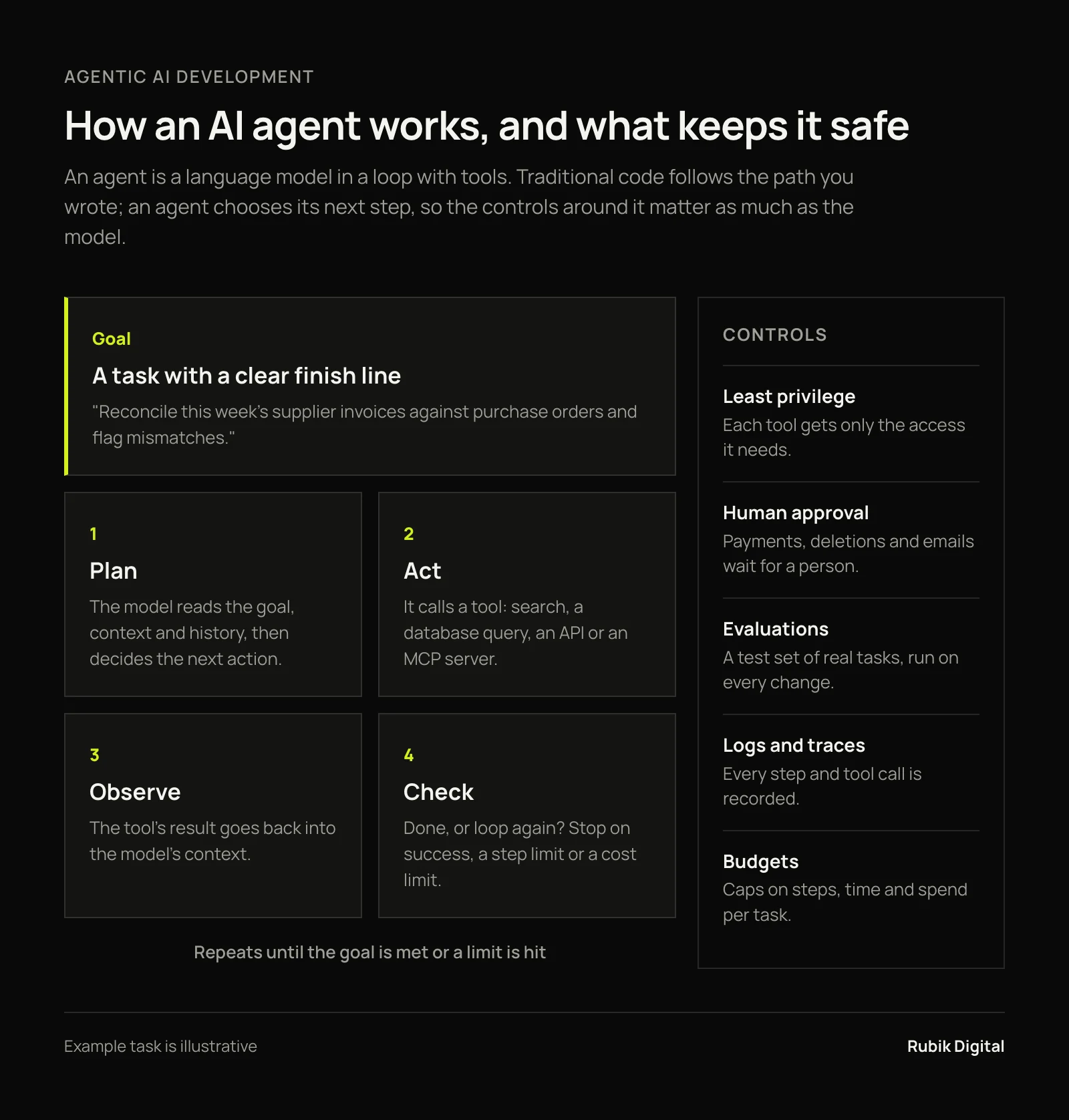
Agentic AI development means building software where a language model works out the steps to reach a goal. Instead of following a path a developer wrote line by line, an agent reads the task, picks a tool, looks at the result and decides what to do next, until the job is done or it hits a limit.
That changes how software is designed, tested and run. This guide explains what is different, when an agent is the right choice and when it isn't, and what it takes to get one from pilot to production. For the basics, start with what agentic AI is.
How agentic AI differs from traditional software
| Traditional software | Agentic AI | |
|---|---|---|
| Logic | Every step written by a developer | The model chooses steps within limits you set |
| Output | Same input, same output | Can vary between runs |
| Testing | Unit tests with exact expected results | Evaluation sets scored on accuracy, cost and time |
| Failure | Errors and exceptions | Confident wrong answers, loops and wrong tool calls |
| Cost | Mostly fixed hosting | Grows with every task, step and model call |
| Security | Protect inputs and endpoints | Also protect against instructions hidden in content the agent reads |
| Change | Behaviour changes when code changes | Behaviour can change when the model, prompt or data changes |
None of this makes traditional engineering less important. Most of an agentic system is still ordinary software: integrations, permissions, queues, logging and a user interface. The model is one component, and usually not the hardest one to get right.
When you need an agent, and when you don't
Many tasks described as agentic don't need an agent. Gartner estimates that only about 130 of the thousands of vendors selling agentic AI are offering the real thing, and warns that many use cases positioned as agentic don't require it. A simple test helps:
| If the task is... | Use | Example |
|---|---|---|
| The same steps every time | Ordinary automation | Copy new form entries into the CRM |
| Fixed steps, with one step needing language understanding | An AI workflow: code that calls a model at set points | Classify incoming emails, then route them |
| Steps that vary case by case and need judgement | An agent | Investigate why an invoice doesn't match its purchase order |
| High risk, with no room for error | Software plus a person, with AI assisting | Approving payments or legal decisions |
Workflows are cheaper, faster and easier to test than agents. Start there, and give the model more freedom only where the fixed version keeps falling short. Our business process automation work usually begins this way.
What an agentic system is made of
- A model. The language model that plans and decides. Different steps can use different models: a cheaper one for routing, a stronger one for reasoning.
- Tools. Functions the agent can call, such as search, database queries, APIs and file access. Each has a clear description and a strict input format.
- MCP. The Model Context Protocol is the open standard for connecting models to tools and data. Anthropic released it in November 2024 and donated it to the Linux Foundation's Agentic AI Foundation in December 2025. One MCP server can make a system's data available to any compatible agent.
- Context and memory. What the agent knows for this task: instructions, retrieved documents, previous steps and, where needed, notes kept between tasks.
- Orchestration. The code that runs the loop, enforces limits, retries failed calls and hands over to a person when needed.
- Guardrails. Checks on inputs and outputs, permission limits and approval steps for risky actions.
- Evaluations and observability. Test sets, scoring and full traces of every step and tool call.
How to build an AI agent: the development process
- Choose one task with a measurable outcome. "Cut time spent reconciling invoices" can be measured; "use AI in finance" can't.
- Map the task as a person does it today. What they look at, which systems they use, what decisions they make and where they get stuck.
- Build the evaluation set first. Collect 50 to 200 real examples with known good outcomes. This is the agent's specification, and it is the work most teams skip.
- Prototype with the fewest tools possible. Add tools only when the evaluation shows the agent needs them.
- Run in shadow mode. The agent works on real tasks, but a person makes the final decision and you compare results.
- Roll out gradually. Hand over low-risk cases first, keep human approval for the rest, and widen the scope as the numbers justify it.
- Monitor and improve. Track accuracy, cost per task, time per task and escalations. Rerun the evaluations on every change to the prompt, model or tools.
“The evaluation set is the real specification. If you can't write down fifty examples of the task done well, you aren't ready to build an agent to do it.”
Testing an agent
You can't unit-test an agent the way you test ordinary code, because the same input can produce different but equally good answers. Instead, teams score agents against the evaluation set on:
- Task success. Did it reach the right outcome?
- Process. Did it use the right tools in a sensible order, without unnecessary steps?
- Cost and time. Model usage and elapsed time per task.
- Safety. Did it stay within its permissions and ask for approval when it should?
Automated scoring, sometimes using a second model as a judge, handles volume. People still review a sample, especially the failures.
Securing an agent
Agents can take actions, so security matters more than with a chatbot. The OWASP Top 10 for Agentic Applications, published in December 2025, lists the main risks, starting with goal hijacking through hidden instructions, misuse of legitimate tools, and abuse of identity and privileges. In practice:
- Treat everything the agent reads as untrusted. Emails, web pages and documents can contain instructions aimed at the model, known as prompt injection.
- Give each tool the least access it needs. Read-only where possible, scoped to specific records, with separate credentials per tool.
- Require approval for irreversible actions. Payments, deletions, external emails and changes to customer data wait for a person.
- Log everything. Every prompt, tool call and result, so you can explain what happened and why.
- Set budgets. Limits on steps, time and spend per task stop runaway loops.
If an agent makes decisions about people, such as customers or job applicants, UK GDPR rules on automated decision-making may apply; check the ICO's guidance before you launch.
What drives the cost
Agentic AI costs come in two parts. The build is mostly integration and testing work: connecting systems, writing tools, building the evaluation set and the approval flow. Running costs scale with use: every task makes several model calls, and a task that takes ten steps costs roughly ten times one that takes one. Estimate cost per task early, multiply by expected volume, and compare it with what the task costs today. Gartner names escalating costs as one of the three main reasons agentic projects get cancelled.
Why agentic AI pilots stall
- No measurable goal, so no one can show the pilot worked.
- The demo used clean data; real data is messy and the accuracy drops.
- No evaluation set, so every change is a guess.
- Too much autonomy too soon, followed by one visible mistake and a loss of trust.
- Integration underestimated. Getting reliable access to legacy systems takes longer than building the agent.
Gartner predicts that over 40% of agentic AI projects will be cancelled by the end of 2027, citing cost, unclear value and weak risk controls. It is a forecast rather than a survey result, but the reasons match what we see: projects that start narrow, measure from day one and add autonomy gradually are the ones that reach production.
Related: our AI development and AI consultancy services, and how agentic AI is changing knowledge work.