
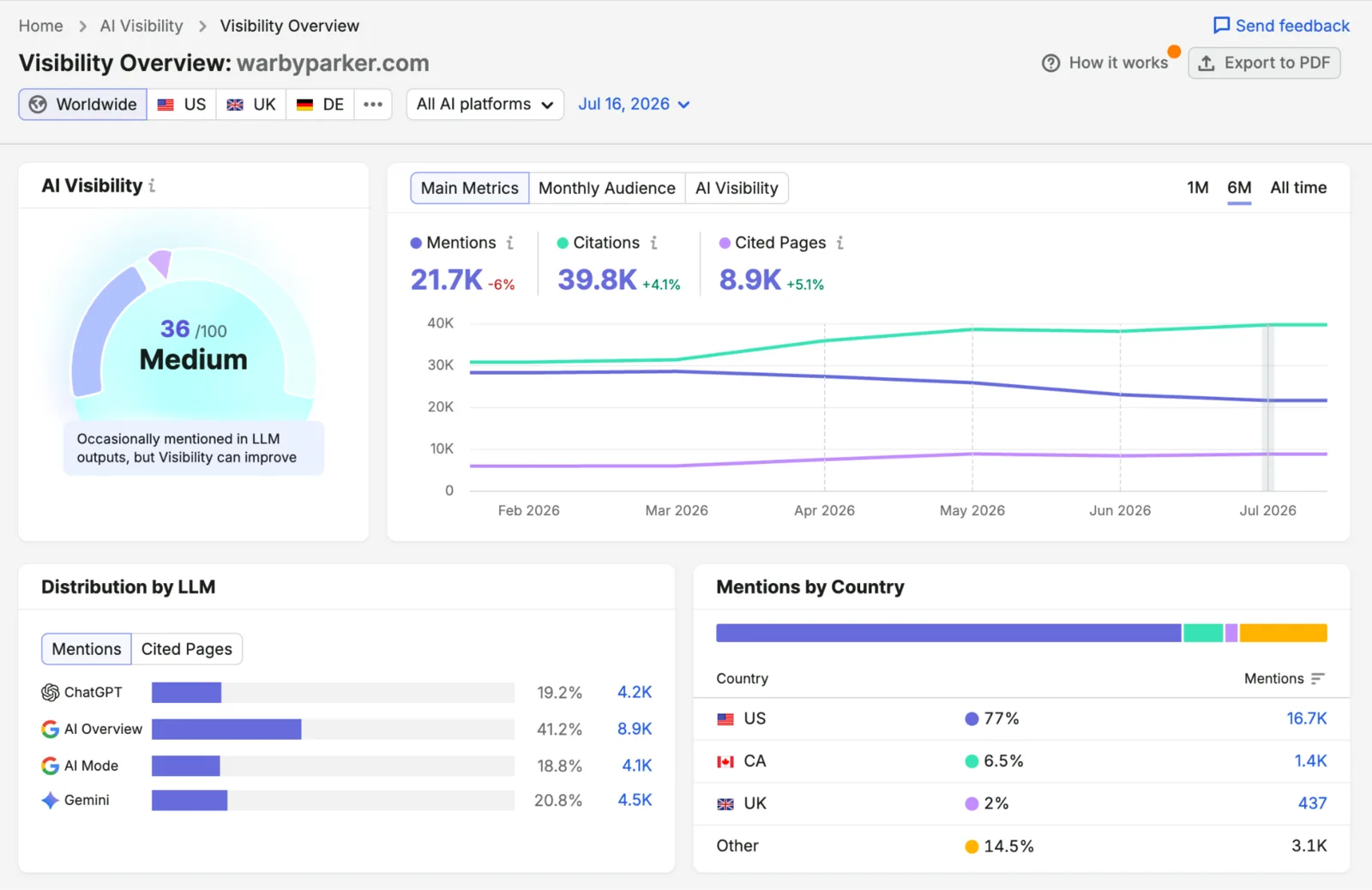
Most AI visibility tools do the same basic job. They send a fixed list of questions, called prompts, to AI assistants such as ChatGPT, Gemini and Google's AI Mode, then record whether your brand is named or your pages are cited in the answers. Where they differ is the price, which AI platforms they cover and how many prompts you get for the money.
This guide compares five paid tools on those three things, using the prices each vendor listed on its own website in October 2026. It also covers the free ways to measure AI visibility, two of which only became available to every website this year, and what our study of 1.4 million crawler requests shows that none of the paid tools can.
Which AI visibility tool should you use?
- No budget: start with Google Search Console's generative AI report, Bing Webmaster Tools' AI Performance report and your GA4 referral data. All three are free.
- Cheapest paid tracker: Otterly.AI Lite at $29 a month for 15 prompts, checked daily.
- Already pay for Semrush or Ahrefs: add their AI module before buying a separate tool. Semrush's AI Visibility Toolkit is $99 a month. Ahrefs includes a few daily AI prompts in every paid plan, with Brand Radar custom prompts from $50 a month.
- More prompts per pound or euro: Peec AI starts at €85 a month for 50 prompts on three AI models of your choice.
- Large brand, many markets: Profound Enterprise, which is priced on request and offers a free seven-day trial.
What does an AI visibility tool measure?
Every tool in this guide reports some mix of four things. A mention is your brand name appearing in an AI answer. A citation is a link to one of your pages as a source. Share of voice is how often you are mentioned compared with your competitors across the same prompts. Sentiment is whether the answer describes you positively, neutrally or negatively.
Keep one limit in mind. AI answers change from one run to the next, and between users, locations and conversations. A tracker asks the same question in the same way every day, so it gives you a trend for a sample of questions, not a ranking position like in Google. Treat the numbers as a regular poll of the AI platforms, and judge them over weeks rather than days.
Four questions to answer before you buy a tool
A prompt tracker answers one question: are you recommended when buyers ask AI for help? That only matters if AI systems can read your site in the first place, and it only pays off if those answers send you visits and enquiries. We check four layers in order, and only the third one needs a paid tool.
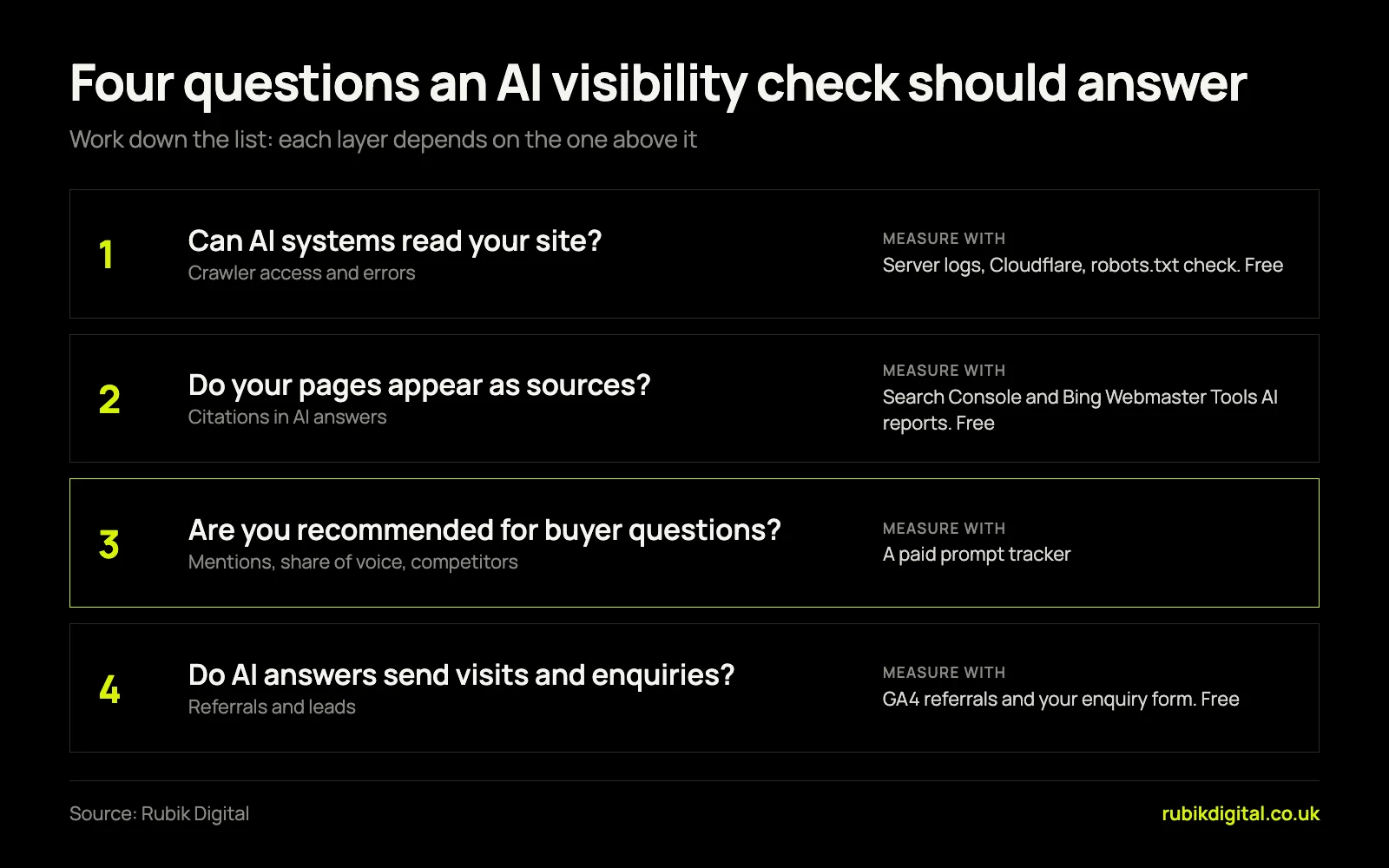
- Can AI systems read your site? Check your server logs or your CDN's bot reports for AI crawlers, and make sure robots.txt isn't blocking the ones you want.
- Do your pages appear as sources? Google and Microsoft now report this for free in Search Console and Bing Webmaster Tools.
- Are you recommended for buyer questions? This is what the paid tools measure: your mentions, citations and share of voice for the prompts you choose.
- Do AI answers send visits and enquiries? Look at AI referrals in GA4, and ask on your enquiry form how people found you.
AI visibility tools compared: price and coverage
Prices are the entry plans as listed by each vendor in October 2026, in the currency the vendor quotes, excluding tax. These tools change their pricing often, so check the vendor's page before you buy.
| Tool | Entry price | What the entry plan includes | AI platforms covered | Free option |
|---|---|---|---|---|
| Otterly.AI | $29 a month (Lite) | 15 prompts checked daily, unlimited team members | ChatGPT, Google AI Overviews, Perplexity and Microsoft Copilot; Claude, AI Mode and Gemini as paid add-ons | Free trial |
| Ahrefs Brand Radar | Custom prompts from $50 a month; AI Visibility Index $199 a month | Daily custom prompts, or instant data from an index of 514 million prompts | AI Overviews, AI Mode, ChatGPT, Perplexity, Gemini and Copilot; Claude for custom prompts | 5 daily prompts with any paid Ahrefs plan; free AI visibility checker |
| Peec AI | €85 a month (Starter) | 50 prompts, 3 AI models of your choice, daily tracking, unlimited seats | Choose from ChatGPT, AI Mode, AI Overviews, Copilot, Gemini and Naver AI; up to 13 models on Enterprise | Free trial |
| Semrush AI Visibility Toolkit | $99 a month | 25 tracked prompts, 1 project, AI search site audit of up to 100 pages | ChatGPT, Gemini, Google AI Overviews and AI Mode | No free trial |
| Profound | Priced on request (Enterprise) | Tailored prompt plan, up to 9 AI platforms, SSO | ChatGPT, Gemini and AI Overviews on the trial; up to 9 platforms on Enterprise | 7-day trial, 50 prompts a day |
What each tool is best at
Otterly.AI: the cheapest way to start
Otterly.AI has the lowest entry price of the five, and every plan includes unlimited team members. Lite covers 15 prompts at $29 a month, Standard 100 prompts at $189 and Premium 400 prompts at $489. The catch is coverage: Google AI Mode, Gemini and Claude are paid add-ons, so the price rises if you need them. It suits a small business that wants to watch a short list of buyer questions without a long contract.
Ahrefs Brand Radar: no setup, and history for any brand
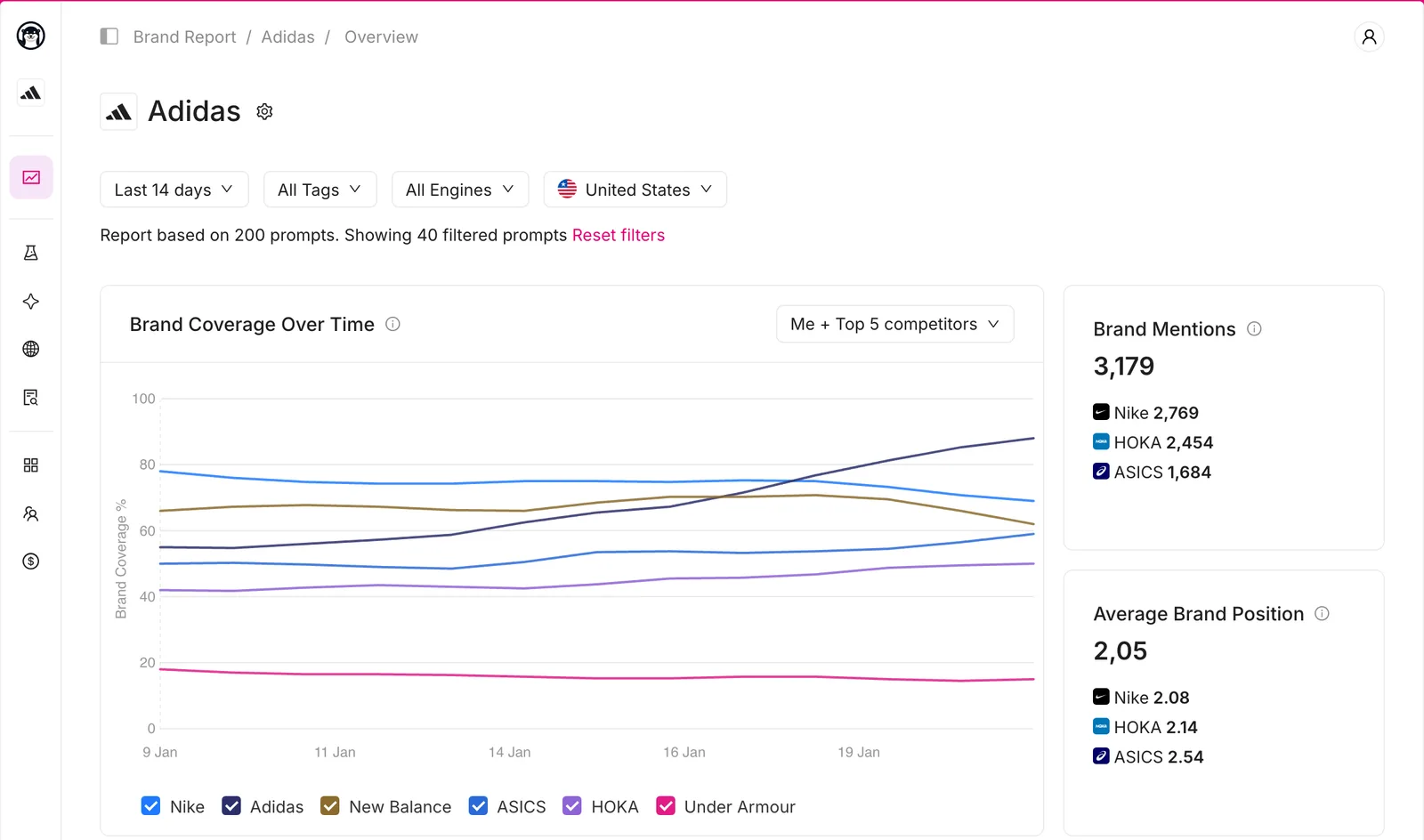
Brand Radar works in two ways. The AI Visibility Index has already run 514 million prompts based on real searches, so you can look up any brand, including competitors, and see its visibility going back to 2025 without choosing prompts. Ahrefs says this works best for brands that people already search for. Custom Prompts tracks the exact questions you choose, which suits newer or niche brands. Every paid Ahrefs plan includes 5 to 20 daily custom prompts, and Ahrefs' Bot Analytics, free while in beta, shows which AI crawlers read your pages.
Peec AI: more prompts for the money
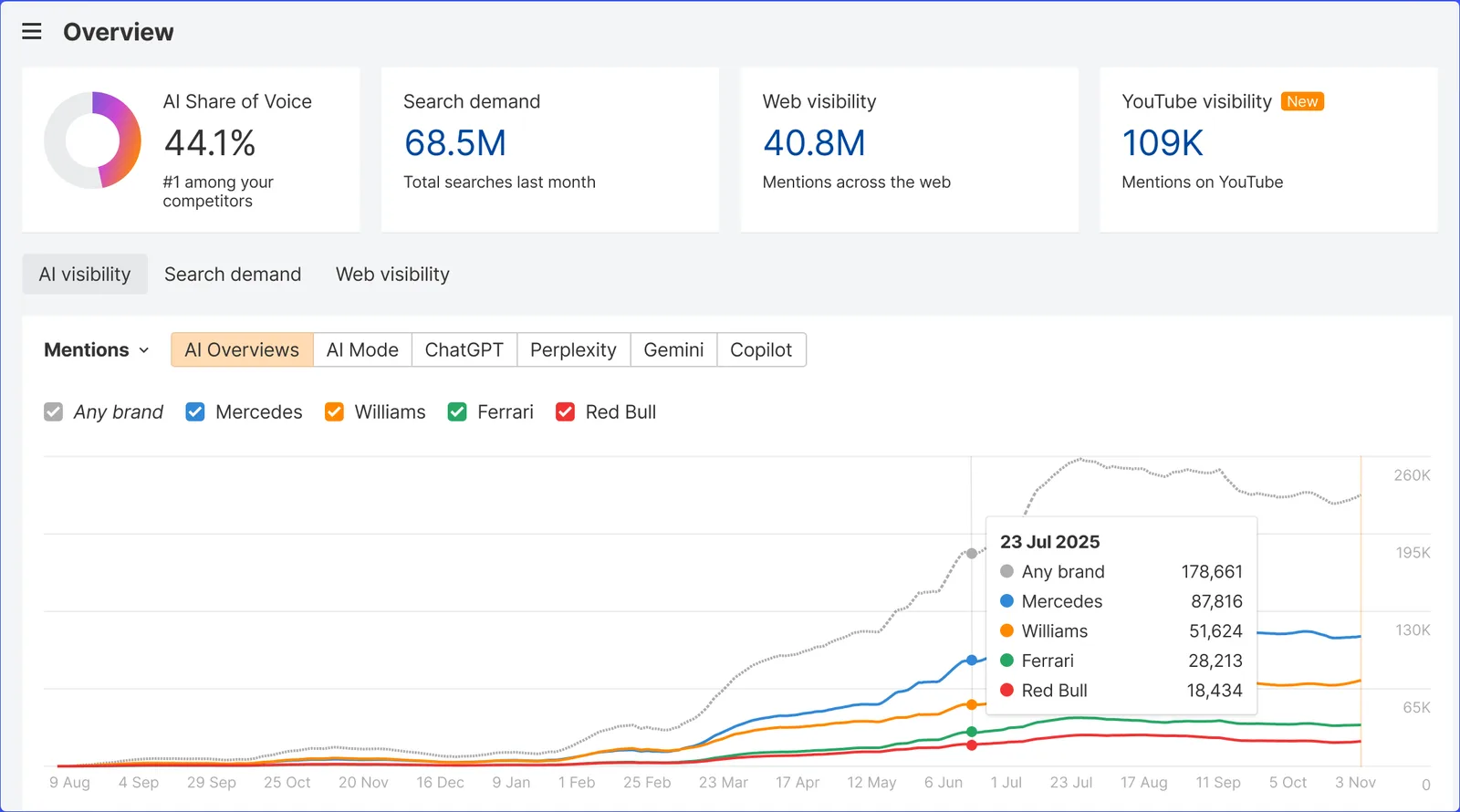
Peec AI shows prices in euros to European visitors: 50 prompts on Starter at €85 a month, 150 on Pro at €205 and 350 on Advanced at €425, all tracked daily. That works out at €1.70 a prompt on Starter and €1.21 on Advanced, compared with about $3.96 a prompt on Semrush's toolkit. Each plan covers three AI models you pick, with extra models at extra cost. Every plan also includes reports on which AI crawlers visit your pages and the visits AI assistants send you, which makes it one of the few trackers that also covers the first and fourth questions above.
Semrush AI Visibility Toolkit: best if you already use Semrush
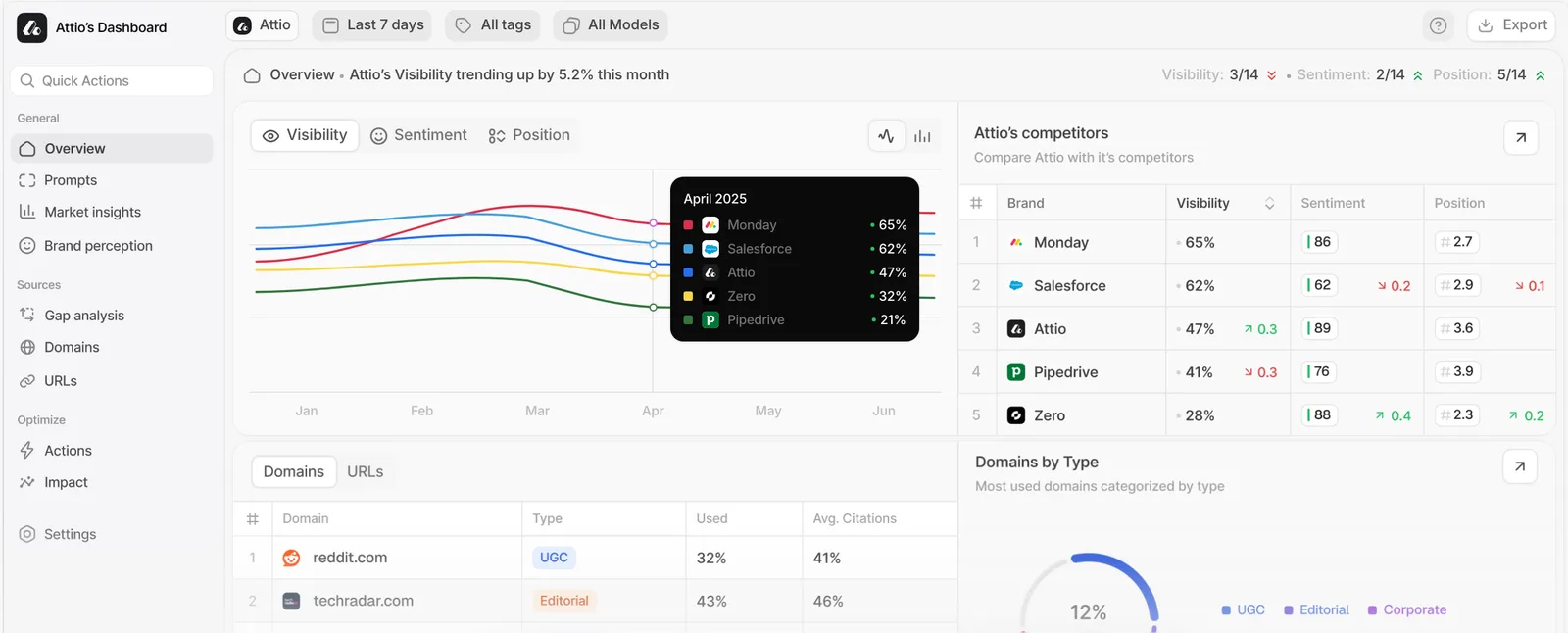
Semrush's toolkit sits beside the SEO data many teams already use. Its Prompt Research report works like keyword research for AI, with topic volume, difficulty and intent, and its site audit flags issues that stop AI crawlers reading your pages. Watch the costs as you grow: 25 tracked prompts is a small list, 50 more cost $60 a month, and each extra user needs their own $99 licence.
Profound: for enterprise teams
Profound is built for large brands with many markets, languages and stakeholders. For brands, its pricing page now lists a free seven-day trial and an Enterprise plan priced on request, so older comparisons that quote fixed monthly brand plans for Profound are out of date. Enterprise covers up to nine AI platforms, single sign-on and a dedicated specialist, plus AI agents for research and content work. It is more than most small and mid-sized businesses need.
Free ways to measure AI visibility
You can answer three of the four questions without paying for anything.
Google Search Console: the generative AI performance report
Since 31 August 2026, every website in Google Search Console has a generative AI performance report. It shows how often your pages appeared in AI Overviews and AI Mode, broken down by page, country, device and date. It reports impressions only: clicks from these features are counted in the main Performance report, not shown separately. If you want to appear there more often, our guide on how to appear in Google AI Overviews and AI Mode covers what to change.
Bing Webmaster Tools: AI Performance
Microsoft's AI Performance report, in public preview since February 2026, shows how often your pages are cited in Microsoft Copilot, Bing's AI-generated summaries and some partner AI services. It lists your most-cited pages and the grounding queries, which are the phrases the AI searched for when it picked your content. Microsoft says the data is a sample rather than a complete log, but it is the only free report that shows the search phrases an AI used when it chose to cite you.
GA4: visits from AI assistants
In Google Analytics 4, filter your traffic by session source for chatgpt.com, perplexity.ai, claude.ai, gemini.google.com and copilot.microsoft.com. This shows which pages AI assistants send people to and whether those visitors go on to enquire or buy. Some AI apps don't pass on where the visitor came from, so part of this traffic shows up as direct and the real figure is higher than GA4 reports.
Server logs: what AI crawlers do on your site
GA4 can't see crawlers at all, because they don't run its tracking code. Your server logs, or the bot reports in Cloudflare and similar services, show which AI crawlers visit, which pages they read and whether they get an error. In our study of 17 business websites, AI crawlers made 40.4% of all 1,440,971 crawler requests over two weeks. That included about 13,000 live visits from assistants such as ChatGPT reading a page because someone had just asked them a question.
The same logs showed that 1.6% of AI crawler requests ended in a server error. A prompt tracker can't see that. If an AI system can't load your page when someone asks about you, it will answer from somewhere else, and no amount of prompt tracking will tell you why.
Spot checks by hand
Once a month, ask five to ten real buyer questions in ChatGPT, Gemini, Perplexity and Google's AI Mode, using a private browser window, and note who gets recommended and which pages are cited. It takes half an hour, it's a useful check on what a paid tool reports, and it's how most businesses find out whether AI visibility is worth paying to track.
How to choose the right AI visibility tool
| Your situation | Where to start |
|---|---|
| You have no budget for tools yet | Search Console, Bing Webmaster Tools, GA4 referrals and monthly spot checks |
| You want to track a handful of buyer questions | Otterly.AI Lite or Peec AI Starter |
| You already pay for Semrush or Ahrefs | Their AI module, before adding another subscription |
| You want to compare yourself with competitors without choosing prompts | Ahrefs Brand Radar's AI Visibility Index |
| You track many brands, markets or languages | Profound or Peec AI Enterprise |
| Your pages don't appear in AI answers at all | Check crawler access in your server logs before paying for tracking |
Choosing your prompts matters more than choosing the tool
A tracker is only as useful as the questions you give it. Twenty prompts that sound like your buyers will tell you more than four hundred generic ones. When you build your list:
- Write prompts the way customers ask, in full sentences, such as "Which accountants in Leeds specialise in property?" rather than "accountants Leeds".
- Mix questions that don't name you with questions that do, so you see both whether you're recommended and what AI says about you.
- Include comparison and alternative questions, where buyers ask AI to choose between you and a competitor.
- Add the location and language for each market you sell in, as answers differ between countries.
- Keep the list the same for at least three months, so changes reflect AI answers rather than your prompts.
What AI visibility tools can't tell you
- Whether you made money. Trackers report mentions and citations, not enquiries or sales. Only your analytics and your enquiry form can show that.
- Why an answer changed. AI platforms update their models and sources without notice, so a drop may have nothing to do with your website.
- What a particular person saw. Real answers depend on the user's history, location and conversation, which no tracker can reproduce.
- Whether crawlers can actually load your pages. Most trackers check robots.txt rules. Only your server logs show the errors and slow responses crawlers really get.
If you'd like help setting this up, our AI search visibility service covers all four layers: crawler access, citations, prompt tracking and the enquiries AI sends you. We'll tell you whether a paid tool is worth it for your business before you buy one.