Good ad copy does one job: it gets the right person to take the next step. It does that by saying something relevant, specific and believable in very few words. Clever wordplay and big adjectives rarely help; a price, a timescale or a reason to trust you usually does.
This guide covers a step-by-step method for writing ads, the formulas worth knowing, examples of weak copy made stronger, the character limits on Google and Meta, and the UK rules every advertiser has to follow.
What is ad copy?
Ad copy is the written part of an advert: the headline, the body text and the call to action. On Google it is the headlines and descriptions in a search ad. On Facebook, Instagram and LinkedIn it is the text above and below the image or video. The same principles apply to your page titles and meta descriptions in organic search, which work as ads for your website; see our guide to meta tags.
How to write ad copy, step by step
1. Pick one audience and one moment
Write for a specific person at a specific point. "A homeowner whose boiler service is due" gives you something to say. "Homeowners" doesn't. If you have two audiences, write two ads.
2. Know what they want right now
Someone searching "emergency plumber near me" wants speed and availability, not your company history. Someone scrolling Instagram wasn't looking for you at all, so the ad has to interrupt with a problem they recognise. Search ads answer a need; social ads create one.
3. Lead with the most relevant benefit
Put the thing they care about most in the first headline or the first line. In search, that usually means repeating what they searched for, so they can see the ad answers it.
4. Be specific
Specific claims are more believable and easier to act on. "Fast delivery" means nothing; "Next-day delivery on orders before 2pm" does. Prices, timescales, numbers, locations and named guarantees all beat adjectives.
5. Answer the main objection
Ask what would stop someone clicking or buying, then answer it in the ad: cost, risk, effort or trust. "No call-out charge", "Cancel anytime" and "Free returns" exist because they remove a reason to hesitate.
6. Give one clear next step
Tell people exactly what happens when they click: "Book a slot", "Get a quote in 2 minutes", "See prices". One action per ad.
7. Match the landing page
The page should repeat the promise the ad made, in the same words, above the fold. If the ad says "From £79" and the page doesn't mention price, many visitors leave. Message match is often worth more than any change to the ad itself; our guide on why websites don't generate leads covers the page side.
8. Write variations and test
Write several versions that differ in one idea, such as price-led versus speed-led, rather than in small wording changes. Then let real results decide.
Ad copy formulas that work
| Formula | Structure | Example |
|---|---|---|
| PAS | Problem, agitate, solution | Boiler service overdue? A missed service can void your warranty. Book a Gas Safe engineer from £79. |
| AIDA | Attention, interest, desire, action | Spending Saturdays on bookkeeping? Connect your bank once and invoices match themselves. Try it free for 30 days. |
| FAB | Feature, advantage, benefit | Merino base layers (feature) regulate temperature (advantage), so you stay comfortable from the car park to the summit (benefit). |
| Before, after, bridge | Life now, life after, how to get there | Chasing invoices by email? Get paid on time instead. Automatic reminders with every invoice. |
Formulas are a starting point, not a script. Use them to make sure the copy covers the problem, the benefit and the action, then cut every word that isn't needed.
Ad copy examples: before and after
| Weak | Stronger | Why |
|---|---|---|
| Quality Accountants You Can Trust | Fixed-Fee Accounts From £95/Month | A price is specific; "quality" and "trust" are claimed by everyone |
| We Are The Leading Removals Company | Same-Week Removals in Bristol | Matches the search and answers the real need, timing |
| Innovative Software Solutions | Rota Planning in 10 Minutes a Week | Says what it does and what you save |
| Shop Our Amazing Range Today! | Free UK Delivery Over £40 | Free Returns | Removes the two most common objections |
The examples are illustrative; any claim like these has to be true and provable for your business.
“The best-performing line in an account is rarely the clever one. It's usually the one with a price or a timescale in it, because it answers the question the searcher was about to ask.”
Character limits by platform
| Platform | Element | Limit or recommendation |
|---|---|---|
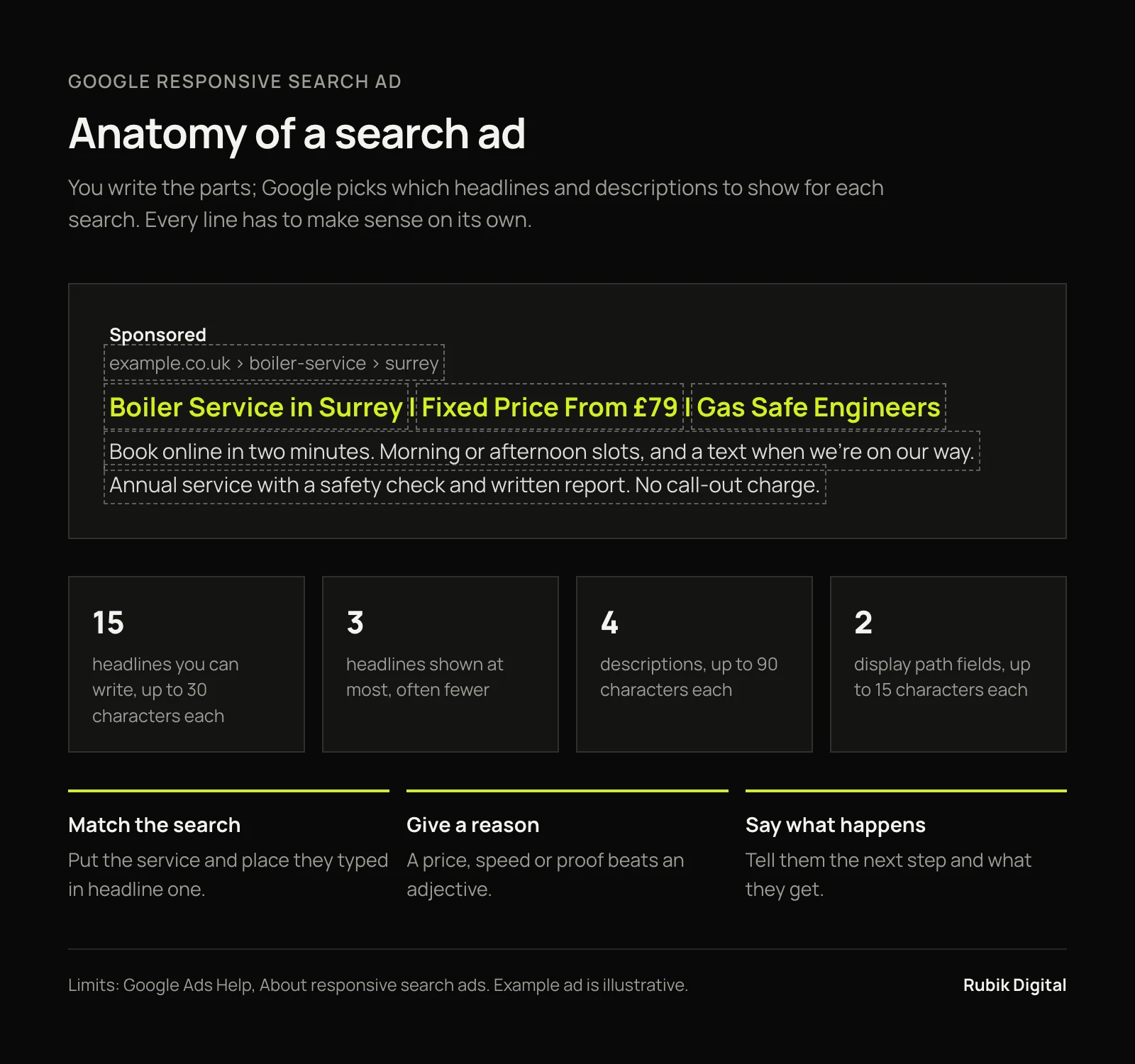
| Google responsive search ads | Headlines | Up to 15, 30 characters each; up to 3 shown |
| Google responsive search ads | Descriptions | Up to 4, 90 characters each; up to 2 shown |
| Google responsive search ads | Display path | 2 fields, 15 characters each |
| Meta (Facebook and Instagram) | Primary text | About 125 characters recommended before it is cut off |
| Meta (Facebook and Instagram) | Headline | About 40 characters recommended |
| Microsoft Advertising | Responsive search ads | Same structure as Google, so imported ads carry across |
Google's limits come from its responsive search ads help page. Meta's figures are recommendations from its ads guide; longer text is allowed but gets truncated.
Writing Google search ads
- Fill most of the 15 headlines. Google needs variety to find combinations that work. Mix keyword headlines, benefits, proof and calls to action.
- Make every headline work alone. Any headline can appear next to any other, in any order.
- Pin sparingly. Pinning a headline to position one guarantees it shows, but limits testing. Pin only what must appear, such as a regulated disclaimer.
- Use the display path. example.co.uk/boiler-service/surrey tells people where they will land.
- Add assets. Sitelinks, callouts and structured snippets take more space and add detail, such as prices or service areas.
- Watch Ad Strength, but judge by conversions. Google reports that advertisers who raise Ad Strength from Poor to Excellent see 12% more conversions on average. Even so, a "Good" ad that converts beats an "Excellent" one that doesn't.
Writing social ads
Social ads interrupt people who weren't looking for you. The first line has to stop the scroll, usually by naming a problem the reader recognises or showing a result they want. Put the hook in the first 125 characters, before "See more". Write the copy to work with the image or video, not to describe it.
How to test ad copy
- Test one idea at a time, such as price versus speed, so you know what made the difference.
- Give each test enough traffic and time; a few dozen clicks prove nothing.
- Judge on conversions and cost per conversion, not click-through rate alone. A provocative headline can win clicks and lose sales.
- Use Google Ads experiments or Meta's A/B testing rather than switching ads on and off.
Search ad tests also tell you which promises to put in your page titles and meta descriptions. Our guide to SEO vs PPC covers how to use paid results to improve organic ones.
Common ad copy mistakes
- Writing about the company ("We are passionate about...") instead of the customer.
- Vague claims such as "best", "leading" or "quality" with nothing to back them up.
- Several calls to action in one ad.
- Ads that promise something the landing page doesn't mention.
- Excessive capitals, exclamation marks and symbols, which Google's editorial policies reject.
- Never testing, so the first draft runs for years.
The UK rules for ad copy
UK adverts must follow the advertising codes enforced by the Advertising Standards Authority (ASA). The rules that catch most advertisers out:
- You need evidence for objective claims. "Cheapest in Surrey" or "Rated number one" needs proof you can show on request.
- Prices must be clear. Consumer prices should include VAT and any unavoidable fees.
- "Free" must mean free, apart from unavoidable delivery costs.
- Comparisons must be fair and based on things that can be checked.
- Urgency must be real. Countdown timers and "only 2 left" must be true.
Since 6 April 2025, the Digital Markets, Competition and Consumers Act 2024 also lets the Competition and Markets Authority fine businesses directly, up to 10% of global turnover, for unfair practices such as fake reviews and misleading pricing.
Using AI to write ad copy
AI tools are good at producing variations quickly, and Google and Meta both offer to generate ad text. Use them for drafts and alternative angles, then edit for your voice and check every claim. AI will invent statistics, guarantees and awards if you let it, and you are responsible for anything that runs. For a wider view, see AI content vs human content.
Related: our conversion rate optimisation service and content optimisation.