For most new projects in 2026, Strapi is the safest open source headless CMS: mature, MIT-licensed and independent of any front end. Payload is the better fit if you build in Next.js and TypeScript, Directus if you must keep an existing SQL database, and a Git-based editor such as Decap, Sveltia or Keystatic if your content is simple and your site is static.
We build and maintain sites on headless platforms, and the content model for this website was built in Strapi 5. This guide focuses on the trade-offs that appear after launch, with facts checked against each project's own documentation in October 2026. Several things changed this year: Strapi 4 reached end of life, Directus changed its licence, Payload 4 entered beta, and Decap is very much back in active development.
The short answer
| If you need | Choose | Why |
|---|---|---|
| A proven, fully open source CMS for any front end | Strapi 5 | MIT licence, largest community, plugin ecosystem |
| A CMS inside a Next.js app | Payload 3 | Same codebase, types and deployment as the site |
| An admin on top of your existing SQL database | Directus | Works with your tables; check the licence |
| Simple content stored in Git | Decap, Sveltia or Keystatic | No database or server to run |
What is an open source headless CMS?
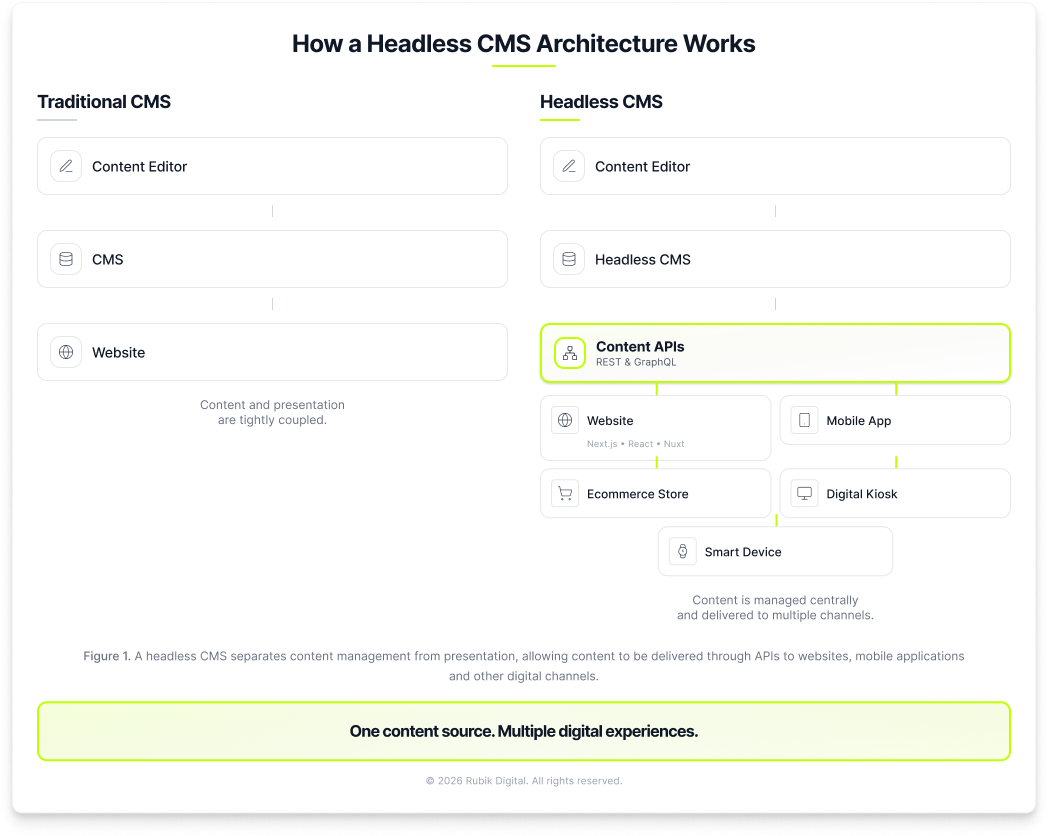
A headless CMS stores and manages content but does not build the pages. It sends content through an API to a front end built in React, Next.js, Nuxt, Astro or anything else, and the same content can feed a website, an app or a kiosk.
"Open source" means the code is published so you can read, change and self-host it. In 2026 that word hides real differences in what the licence allows:
- Permissive open source (MIT): use it commercially without restrictions. Strapi, Payload, Decap, Sveltia and Keystatic are MIT-licensed.
- Source-available: the code is public, but larger organisations may need a paid licence. Directus is in this group.
If avoiding lock-in is why you want open source, read the licence before you choose.
Strapi 5
Strapi is the most widely used open source headless CMS. It runs on Node.js, stores content in SQLite, PostgreSQL or MySQL, and offers REST and GraphQL APIs. It is MIT-licensed and works with any front end.
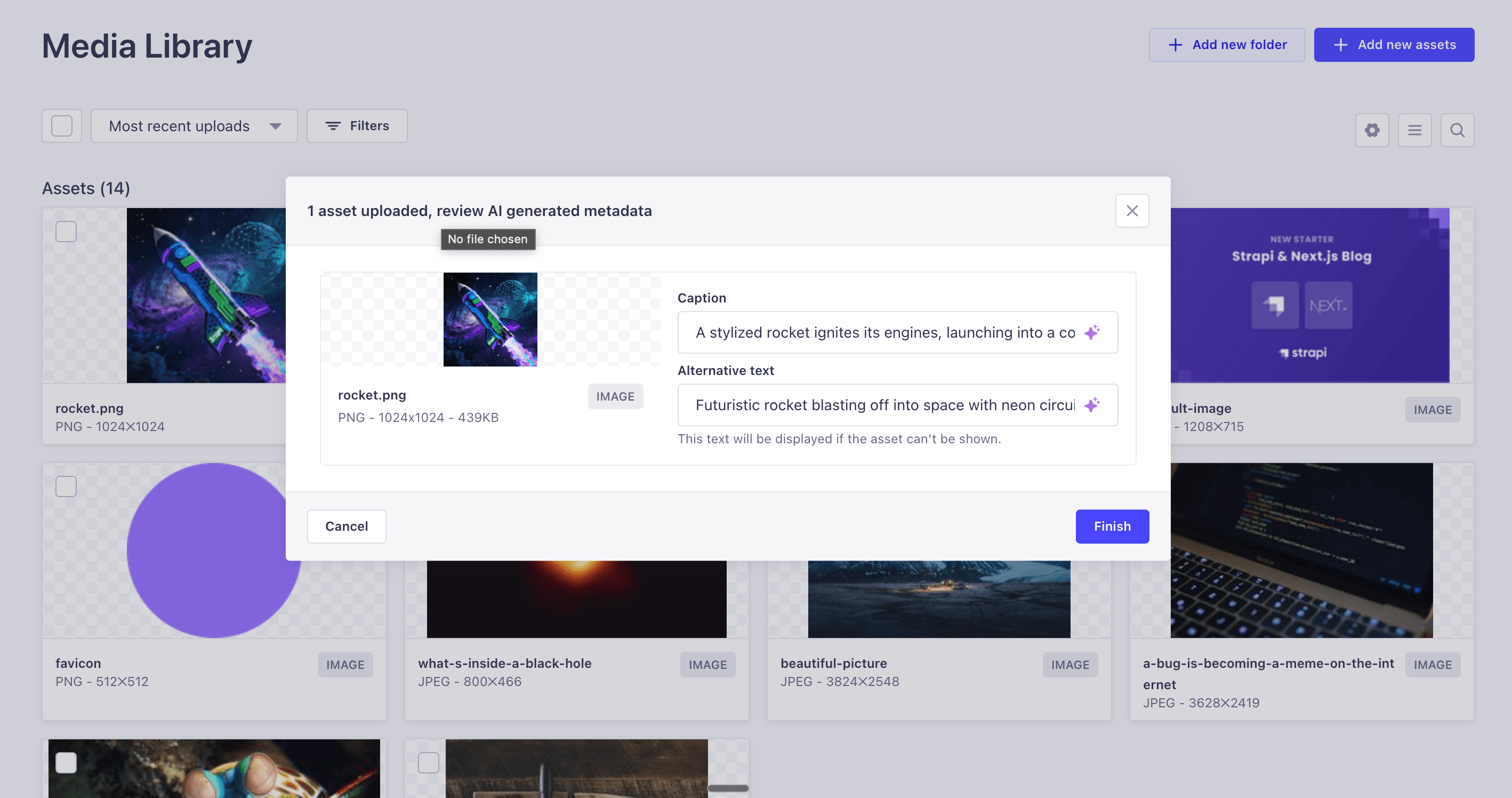
Strapi 4 reached end of life on 30 April 2026, and its final release, 4.26.2, shipped in June 2026 with a critical security fix. New projects should start on Strapi 5, which Strapi supports as its long-term release; version 5.60 shipped on 28 October 2026. Strapi 5 brought a new Document Service API, draft and publish with content history, live preview and a built-in MCP server for AI tools.
When we modelled this site's insights and case studies in Strapi 5, two choices paid off. We kept the article body to a single rich-text field with an editor limited to what the site's template can render, so editors cannot add formatting the front end would break. We also kept the admin form layouts in code, so they are reapplied on every start instead of drifting between environments.
Best for: teams that want a mature, fully open source CMS that does not tie them to a front end. Watch for: Strapi runs as its own service, so you host, update and back it up separately from the website.
Directus
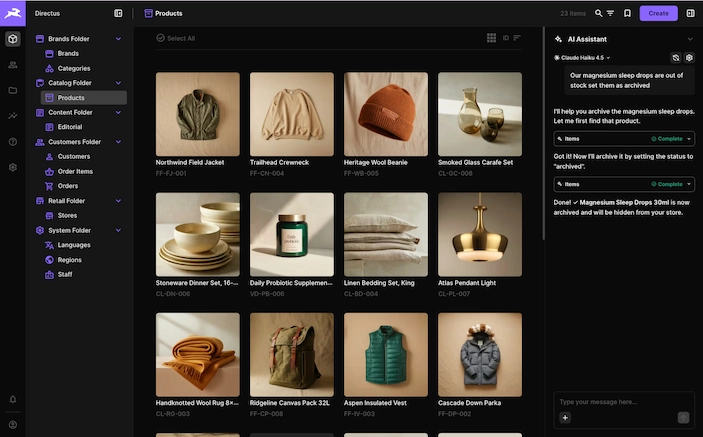
Directus works differently. Instead of owning its own content store, it sits on top of a SQL database you already have and generates REST and GraphQL APIs from your tables. Your data stays in your database, in your schema, whether or not you keep Directus.
The licence changed in 2026. With version 12 in May, Directus moved from the Business Source License to the Monospace Sustainable Core License, a source-available licence. In practice:
- Organisations under $5M annual revenue and fewer than 50 employees can use the full platform free through the Open Innovation Grant, which is renewed yearly.
- Larger organisations can still self-host free within the Core tier's limits (3 users and 25 collections), or pay for Team or Enterprise.
- Directus Cloud starts at $99 a month, or $89 a month billed yearly.
- Each version becomes GPLv3 open source four years after release.
Best for: projects built around an existing relational database, internal tools and data-heavy apps. Watch for: the revenue and headcount thresholds, licence keys on self-hosted installs, and the Core tier's limits if you do not qualify for the grant.
Payload 3
Payload is a TypeScript-first, MIT-licensed CMS that installs inside a Next.js app. The admin, the API and the website share one codebase, one set of types and one deployment. Its Local API lets server components read content directly from the database, without an HTTP request.
Figma acquired the Payload team in June 2025, and Payload has stayed MIT-licensed and actively developed since. Version 3 is the stable release (3.92 at the end of October 2026), and version 4 has been in beta since October 2026. It supports PostgreSQL, MongoDB and SQLite, and deploys to Vercel, Cloudflare or any Node.js host.
Best for: teams already committed to Next.js and TypeScript who want the CMS and site as one project. Watch for: a steeper learning curve, a less natural fit outside React and Next.js, and a version 4 upgrade to plan for on new builds.
Decap, Sveltia and Keystatic: Git-based options
Git-based editors store content as Markdown, YAML or JSON files in your repository and commit changes through a browser editor. There is no database or CMS server to run, which suits static sites built with Astro, Hugo, Eleventy or Next.js.
- Decap CMS, formerly Netlify CMS, is MIT-licensed and actively maintained again. Releases 3.17.0 to 3.17.3 shipped in October 2026 with security fixes, a new rich-text editor and Decap Turbo, an optional paid hosted backend for sign-in, permissions and faster large collections.
- Sveltia CMS reads Decap's configuration format, so switching is usually small. It is still in beta, with version 1.0 planned for late 2026, and is maintained by one developer who releases several times a week.
- Keystatic, from Thinkmill, defines content in TypeScript and works with Astro and Next.js. It is MIT-licensed and actively developed but still below version 1.0, so pin exact versions.
Best for: small content sites, documentation and marketing sites where editors are comfortable with a simple form. Watch for: Git-based tools are not built for large relational data, many editors working at once or complex permissions.
Open source headless CMS comparison
| CMS | Licence | Built on | Content stored in | Free to self-host? |
|---|---|---|---|---|
| Strapi 5 | MIT | Node.js | SQLite, PostgreSQL or MySQL | Yes |
| Directus | Source-available (MSCL) | Node.js | Your existing SQL database | Free under $5M revenue and 50 staff; Core tier limits above |
| Payload 3 | MIT | Next.js and TypeScript | PostgreSQL, MongoDB or SQLite | Yes |
| Decap | MIT | Browser app, Git | Files in your repository | Yes; Turbo hosting is paid |
| Sveltia | MIT | Browser app, Git | Files in your repository | Yes (beta) |
| Keystatic | MIT | React, Astro or Next.js | Files in your repository | Yes |
Strapi vs Directus vs Payload: how to decide
- Do you have a SQL database that has to stay? Choose Directus. It is the only one of the three built to work on an existing schema.
- Is the site built in Next.js and TypeScript? Choose Payload. One codebase and direct database reads are a real advantage there.
- Do you want the safest fully open source option that works with any front end? Choose Strapi.
| Strapi 5 | Directus | Payload 3 | |
|---|---|---|---|
| Licence | MIT | Source-available | MIT |
| Data model | Its own database | Your existing database | Its own database |
| Front end | Any | Any | Next.js native |
| APIs | REST, GraphQL | REST, GraphQL | REST, GraphQL, Local API |
| Learning curve | Moderate | Moderate | Steeper |
| Managed hosting | Strapi Cloud | Directus Cloud | Vercel or Cloudflare templates |
“Pick the CMS that matches where your data lives and what your front end is built in. Popularity matters less than fit, and changing CMS later costs far more than choosing carefully now.”
How much does an open source headless CMS cost?
Free to download is not free to run. The licence is usually the smallest cost.
| Cost | What to budget for |
|---|---|
| Licence | Free for Strapi, Payload and the Git-based tools. Directus is free under its grant thresholds; above them, Core limits or a paid tier apply. |
| Hosting | A server or platform, database, backups and monitoring. Managed clouds cost more but save time. |
| Development | Usually the largest cost: the content model, the front end and integrations. |
| Maintenance | Security updates and major-version upgrades, such as Strapi 4 to 5 or Payload 3 to 4. |
| Editor training | A headless admin looks different from WordPress; plan a short handover. |
Our guide to headless CMS vs WordPress compares the running costs with a traditional CMS.
Questions to answer before you choose
- What content types and relationships do you need to model?
- Which front-end framework are you committed to?
- Is there an existing database that has to stay?
- What is your organisation's revenue and headcount, and does that affect the licence?
- Who will host, update and patch the CMS?
- How technical are your editors, and how many will work at once?
- Will you need several sites, brands or languages?
If you are still weighing headless against a traditional CMS, see headless CMS vs traditional CMS. For help with a build, our headless CMS development team works with Strapi and Payload.
Our verdict
There is no single best open source headless CMS. For most teams, start with Strapi. Choose Payload when you are committed to Next.js and TypeScript, Directus when your data already lives in a SQL database and the licence suits your size, and Decap, Sveltia or Keystatic for simple content in Git. Get the architecture and licence right at the start and you avoid an expensive rebuild later.