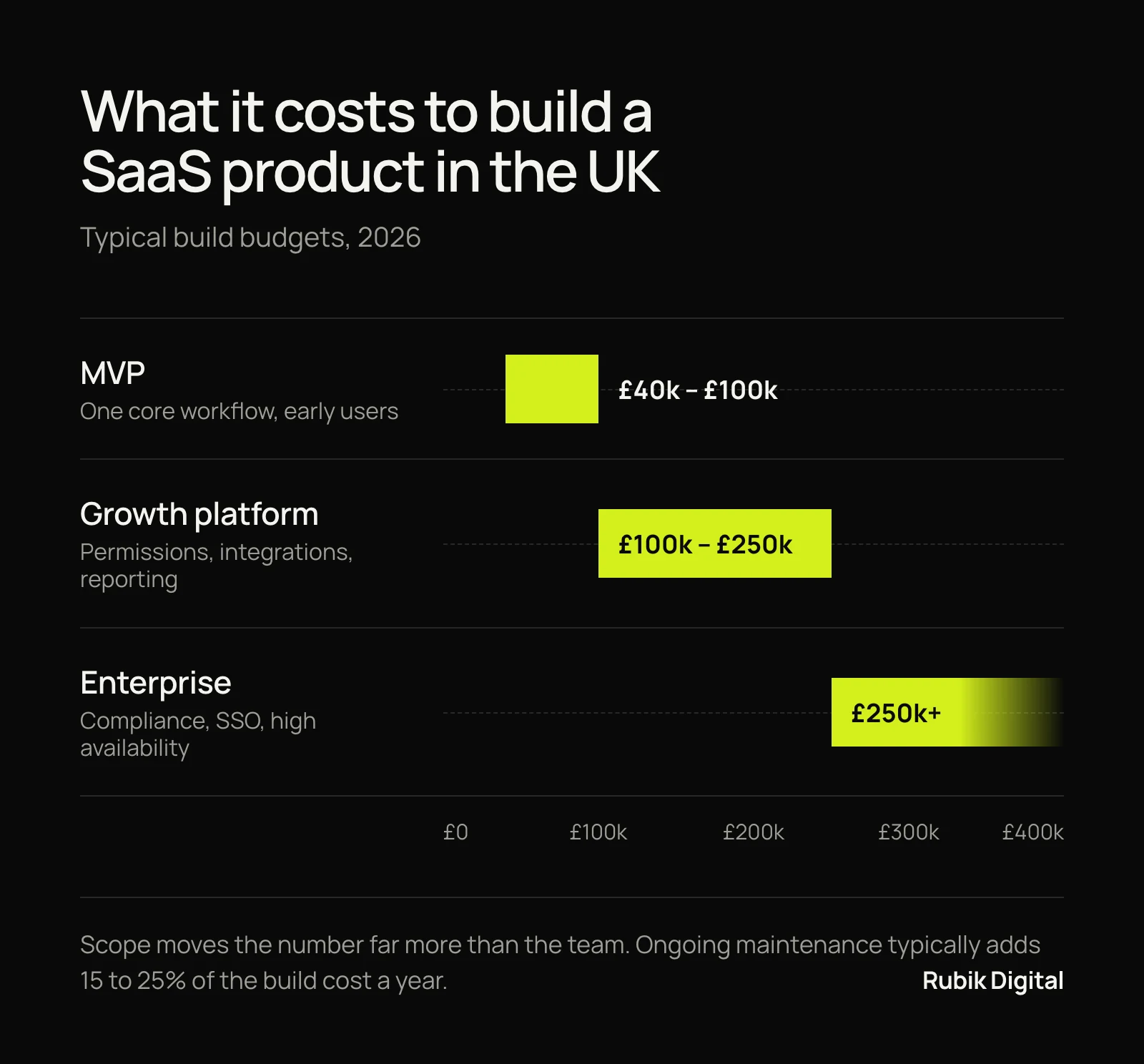
The honest answer is a range: most UK SaaS products cost £40,000 to £250,000 or more to build, and where you land depends far more on scope than on who builds it. This guide shows what drives the number, current UK day rates and salaries, a worked MVP budget, and what it costs to keep a product running after launch.
SaaS development costs at a glance
| Stage | Typical cost | What you usually get |
|---|---|---|
| MVP | £40,000 to £100,000 | One core workflow, accounts, basic billing, admin, launch to early users |
| Growth platform | £100,000 to £250,000 | Roles and permissions, integrations, reporting, multi-tenant data, polish |
| Enterprise platform | £250,000+ | Compliance, SSO, audit trails, high availability, complex integrations |
What drives the cost
Scope
The number of workflows matters more than the number of screens. An MVP that does one job well, such as booking, quoting or reporting, costs a fraction of one that tries to cover a whole process on day one.
Complexity
Multi-tenant data, roles and permissions, subscription billing with trials and proration, file processing, real-time features and AI features all add weeks. So does every integration with a CRM, accounting package or third-party API, especially if its documentation is poor.
Compliance and security
Selling to larger businesses often means SSO, audit logs and evidence for frameworks such as ISO 27001 or SOC 2. Fintech and health products carry extra regulatory work. These are cheaper to design in from the start than to add later.
Team model
Contractors, an agency or an in-house team can build the same product at very different costs and speeds. The sections below compare them.
UK day rates in 2026
These are median contractor day rates from UK job ads in the six months to late October 2026, as reported by IT Jobs Watch, with the middle half of quoted rates alongside.
| Role | Median day rate | Middle 50% of rates |
|---|---|---|
| React developer | £525 | £425 to £725 |
| Backend developer | £529 | £500 to £600 |
| DevOps engineer | £525 | £461 to £613 |
| Product designer | £415 | £400 to £513 |
Agencies usually charge more per day than individual contractors because the rate includes project management, quality assurance, senior oversight and continuity if someone is unavailable.
A worked MVP budget
Here is an illustrative budget for a lean MVP: one core workflow, built by a product designer and two developers over roughly 14 weeks, at the median rates above.
| Role | Days | Rate | Cost |
|---|---|---|---|
| Product designer | 20 | £415 | £8,300 |
| Frontend developer | 60 | £525 | £31,500 |
| Backend developer | 60 | £529 | £31,740 |
| DevOps engineer | 8 | £525 | £4,200 |
| Total | 148 | £75,740 |
Add project management, testing and a contingency of 15 to 20% and a realistic budget is roughly £87,000 to £91,000. This is an illustrative calculation, not a quote. Cutting the first release to the single workflow that proves people will pay is the most reliable way to bring it down.
Building an in-house engineering team instead
Hiring your own team gives you control and keeps knowledge in the business, but it costs more than salaries suggest. The median UK software engineer salary is £70,000 according to IT Jobs Watch. On top of that, employers pay 15% National Insurance on earnings above £5,000 a year (£9,750 on a £70,000 salary) and at least about £1,300 in minimum workplace pension contributions.
| Role | Median salary | Approximate cost to employer |
|---|---|---|
| Software engineer | £70,000 | About £81,000 |
| Senior software engineer | £75,000 | About £87,000 |
| Senior product designer | £75,000 | About £87,000 |
A small team of three engineers and a senior product designer therefore costs around £330,000 a year before recruitment fees, equipment, software licences, office costs and management time. Hiring also takes months. That is why many founders build the MVP with an agency or contractors, then hire once the product has paying customers and a clear roadmap.
| Option | Best when | Watch out for |
|---|---|---|
| Agency | You need a complete team quickly and a fixed scope | Knowledge transfer and code ownership |
| Contractors | You have a strong technical lead to direct them | Coordination and continuity |
| In-house team | The product has traction and a long roadmap | Cost, hiring time and keeping people |
| Hybrid | You want to start fast and bring work in-house later | Agree handover and documentation up front |
How long SaaS development takes
| Phase | Typical duration | What happens |
|---|---|---|
| Discovery and product strategy | 2 to 4 weeks | Users, core workflow, scope and technical plan |
| UX and product design | 3 to 6 weeks | Journeys, prototypes, design system |
| Build | 2 to 6 months | Frontend, backend, integrations, infrastructure |
| Testing and launch | 2 to 6 weeks | QA, security checks, beta users, release |
A focused MVP usually reaches launch in three to six months. Growth platforms take six to twelve months, and enterprise platforms longer.
Ongoing costs after launch
- Maintenance and development. A common rule of thumb is 15 to 25% of the build cost each year, more if you keep adding features.
- Cloud hosting. Often a few hundred pounds a month at launch, rising with users, data and availability requirements.
- Third-party services. Authentication, email delivery, error monitoring, analytics and backups each carry a monthly fee.
- Payments. Stripe's standard fee for UK cards is 1.5% plus 20p per transaction, plus extra for subscription billing features.
- Security. Dependency updates, penetration testing before larger customers sign, and incident response.
- Support. Someone has to answer customers and triage bugs.
How to reduce the cost without cutting corners
- Build one workflow brilliantly before building five adequately.
- Use proven managed services for authentication, billing and email rather than writing your own.
- Use an off-the-shelf admin panel for internal tools.
- Design a small component library early so new screens are faster to build.
- Launch to a small group of paying users and let their behaviour decide what comes next.
“The most expensive SaaS feature is the one nobody uses. A tight first release costs less, launches sooner and tells you what to build next.”
Choosing a SaaS development partner
Look for a team that challenges your scope, shows you live products rather than mockups, explains how they handle security and billing, and agrees up front that you own the code and accounts. Our SaaS development and web application development services show how we work, and when the product is live, our SaaS SEO service helps it get found. For marketing site costs rather than product costs, see our website development cost guide.