Content marketing improves SEO by giving search engines useful pages to rank. A good guide can rank for dozens of related searches, earn links from other sites, appear as a source in AI answers and send readers on to your service pages. Without content, SEO has very little to work with.
This guide covers the seven benefits that matter in 2026, how AI Overviews have changed the job, a process you can follow, and how long it realistically takes. The examples come from how we plan content on our own site.
The short answer: 7 benefits of content marketing for SEO
- More keywords: every useful page can rank for many related searches, not just one.
- Topical authority: connected pages on one subject show you know it in depth.
- Natural backlinks: people link to useful resources, rarely to sales pages.
- AI citations: clear, specific answers are the pages AI Overviews and assistants link to.
- Better internal linking: content creates natural paths to your important pages.
- Every stage of buying: guides for researchers, comparisons for shortlisters, pages for buyers.
- Compounding traffic: good pages keep earning visits long after they are published.
What is content marketing in SEO?
Content marketing in SEO means planning, writing and improving pages around the questions your customers search for. That includes guides, comparisons, cost pages, case studies, FAQs, tools and service pages.
SEO and content marketing do different jobs. SEO finds the demand and makes sure pages can be crawled, understood and ranked. Content marketing creates the pages worth ranking. Put simply, SEO tells you what people are searching for; content gives them a reason to choose you.
1. Content helps you rank for more keywords
A service page might target "SEO agency". The people who eventually hire an agency search for much more than that first: how much SEO costs, how long it takes, what an audit includes. Each of those questions is a chance to be found earlier.
One strong page often ranks for hundreds of variations. Our own SEO cost guide appears for searches as different as "SEO pricing UK", "freelance SEO rates" and "local SEO services cost", because it answers all of them on one page.
2. Content builds topical authority
Topical authority is the idea that a site becomes trusted for a subject by covering it thoroughly across connected pages. One article about SEO is not enough. A cluster that covers costs, audits, on-page work and measurement shows depth.
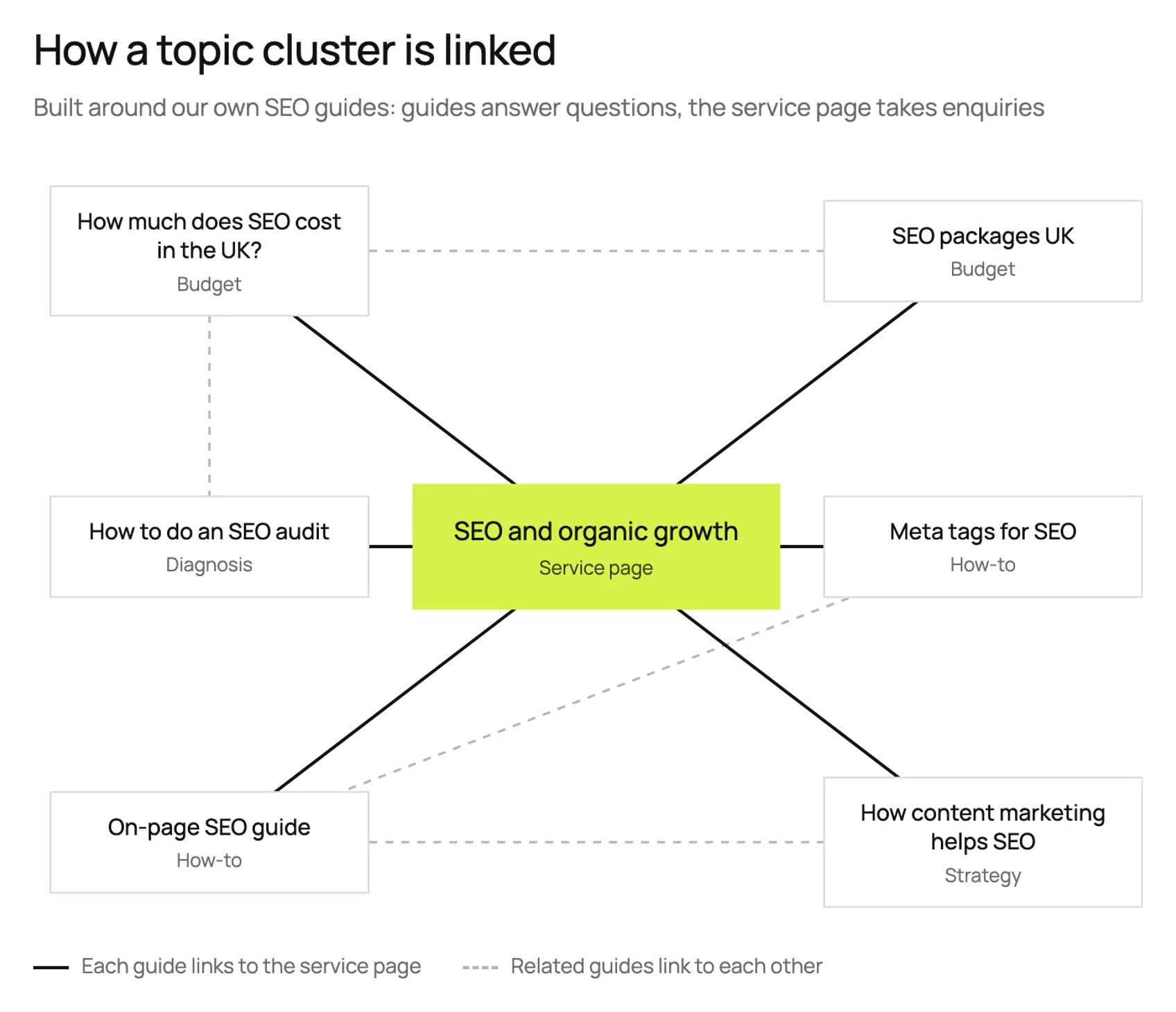
A cluster built around our own SEO pages links guides such as SEO packages, meta tags for SEO and the on-page SEO guide to each other and to the SEO and organic growth service page. Readers can move between related questions, and search engines can see how the pages relate.
3. Content earns backlinks naturally
Links from other trusted sites remain one of the clearest signals that a page is worth ranking. People rarely link to a sales page. They link to things that help their own readers:
- Original research or data
- Price guides and benchmarks
- Clear explanations of difficult topics
- Comparisons and checklists
- Free tools and calculators
If links are part of your plan, our guide to what backlinks are explains which ones are worth having.
4. Content gets you cited in AI answers
AI Overviews and AI Mode now sit above many Google results, and assistants such as ChatGPT, Copilot and Perplexity answer questions with links. Google's guidance is clear that there is no special trick: the same SEO best practices apply, and a page must be indexed and eligible to show a snippet to appear as a supporting link.
Google also says AI features may run several related searches behind the scenes, which it calls query fan-out, to build an answer. A page that answers the main question and the obvious follow-ups has more chances to be picked. In practice, that means direct answers near the top, specific numbers and examples, and headings that match the questions people ask.
For more on this, see our guide to appearing in Google's AI Overviews and AI Mode.
5. Content strengthens internal linking
Internal links help search engines find pages and understand which ones matter. They also guide readers from an answer to a next step. Each new article is a chance to link to a service page, a case study or a related guide, using descriptive link text rather than "click here".
Content that sits on its own, with no links in or out, is the most common waste we see in content programmes. Plan where each new page will be linked from before it is written.
6. Content supports every stage of buying
| Stage | What the reader needs | Content that fits |
|---|---|---|
| Researching | Understand the problem | Guides, explainers, "what is" pages |
| Comparing | Weigh up options and costs | Cost guides, comparisons, checklists |
| Deciding | Choose a provider | Service pages, case studies, FAQs, pricing |
Traffic only matters if some of it becomes enquiries. Every educational page should offer a sensible next step, such as a related guide, a case study or a short form, not a hard sell.
7. Content keeps earning traffic
Paid search stops when the budget stops. A useful page can keep attracting visitors for years if it stays accurate. That makes content an asset, but only if someone maintains it: prices change, tools change, and competitors improve their pages.
“The best-performing content we have is rarely the newest. It is the page we went back to, checked against what people were actually searching for, and made better.”
Content marketing vs SEO: what is the difference?
| SEO | Content marketing | |
|---|---|---|
| Main focus | Being found in search | Being useful and trusted |
| Typical work | Keyword research, technical fixes, on-page work, links | Guides, comparisons, case studies, research |
| Success looks like | Rankings, impressions, organic visits | Engagement, links, enquiries |
| Without the other | Little to rank | Hard to find |
Which types of content help SEO most?
| Content type | Typical search | SEO job |
|---|---|---|
| Cost or pricing guide | "How much does X cost UK" | Captures buyers setting a budget |
| How-to guide | "How to do X" | Ranks for many long questions, earns links |
| Comparison | "X vs Y" | Reaches people choosing between options |
| Case study | Brand and sector searches | Proves results, supports decisions |
| Tool or calculator | "X calculator" | Earns links and repeat visits |
| Glossary or definition | "What is X" | Wins quick answers and AI citations |
How long does content marketing take to improve SEO?
| Timeframe | What usually happens |
|---|---|
| First weeks | Google discovers the page and starts showing it for some searches |
| 1–3 months | Rankings for longer, less competitive questions |
| 3–6 months | More stable rankings and traffic for stronger pages |
| 6–12 months | Clusters and links make the whole topic stronger |
Impressions arrive before clicks. Between August and October 2026, our SEO cost guide was shown in Google around 89,000 times, mostly on page one, but it earned far fewer clicks than that exposure deserved. That told us Google understood the page and that the title and opening needed to answer the price more directly. Search Console data like this is the best guide to what to fix next.
A simple SEO content process
| Step | What you do | Result |
|---|---|---|
| Research | Find the questions buyers search for, with Search Console and a keyword tool | Topics with real demand |
| Map intent | Decide whether each search needs a guide, comparison or service page | The right format for each search |
| Brief | Set the main question, the follow-ups, examples and internal links | Writers know what good looks like |
| Write | Answer first, then explain, with first-hand detail | A page worth ranking and citing |
| Publish and link | Add links from related pages and the service page | Faster discovery and clearer structure |
| Measure and refresh | Review impressions, clicks and leads every quarter | Pages that keep improving |
Common content marketing mistakes
| Mistake | Why it hurts |
|---|---|
| Writing without checking demand | Nobody searches for the topic |
| Covering the same question twice | Two pages compete and neither ranks well |
| Thin or generic articles | Nothing new compared with what already ranks |
| No internal links | Pages are hard to find and do not support services |
| Changing dates without real changes | Google lists this as a warning sign, and readers notice |
| Writing to a word count | Google says it has no preferred length |
| No next step for the reader | Traffic that never becomes enquiries |
Google's guidance on helpful content asks whether a page offers original information, a complete answer and real expertise, and whether readers leave satisfied. It is the best checklist for any brief. Our guide to AI content vs human content covers where AI tools fit in that process.
How to measure content marketing for SEO
- Impressions: whether Google shows the page at all, and for which searches.
- Clicks and click-through rate: whether the title and description earn the visit.
- Average position: pages between 8 and 20 are often the quickest wins.
- Enquiries and assisted conversions: whether readers go on to contact you.
- Links earned: whether other sites find the page worth citing.
Our Google Search Console guide shows how to find those numbers, and our content strategy guide covers how to plan what comes next. If you want help, our content optimisation team can review what you have and plan what to write.