E-commerce, short for electronic commerce, is buying and selling goods or services online. An online clothes shop, a supplier taking trade orders through a portal, a software subscription and a seller on eBay are all e-commerce.
In Great Britain, more than a quarter of all retail spending now happens online. This guide explains how e-commerce works, the main types and platforms, what it costs to set up, the UK rules and how to start.
How big is e-commerce in the UK?
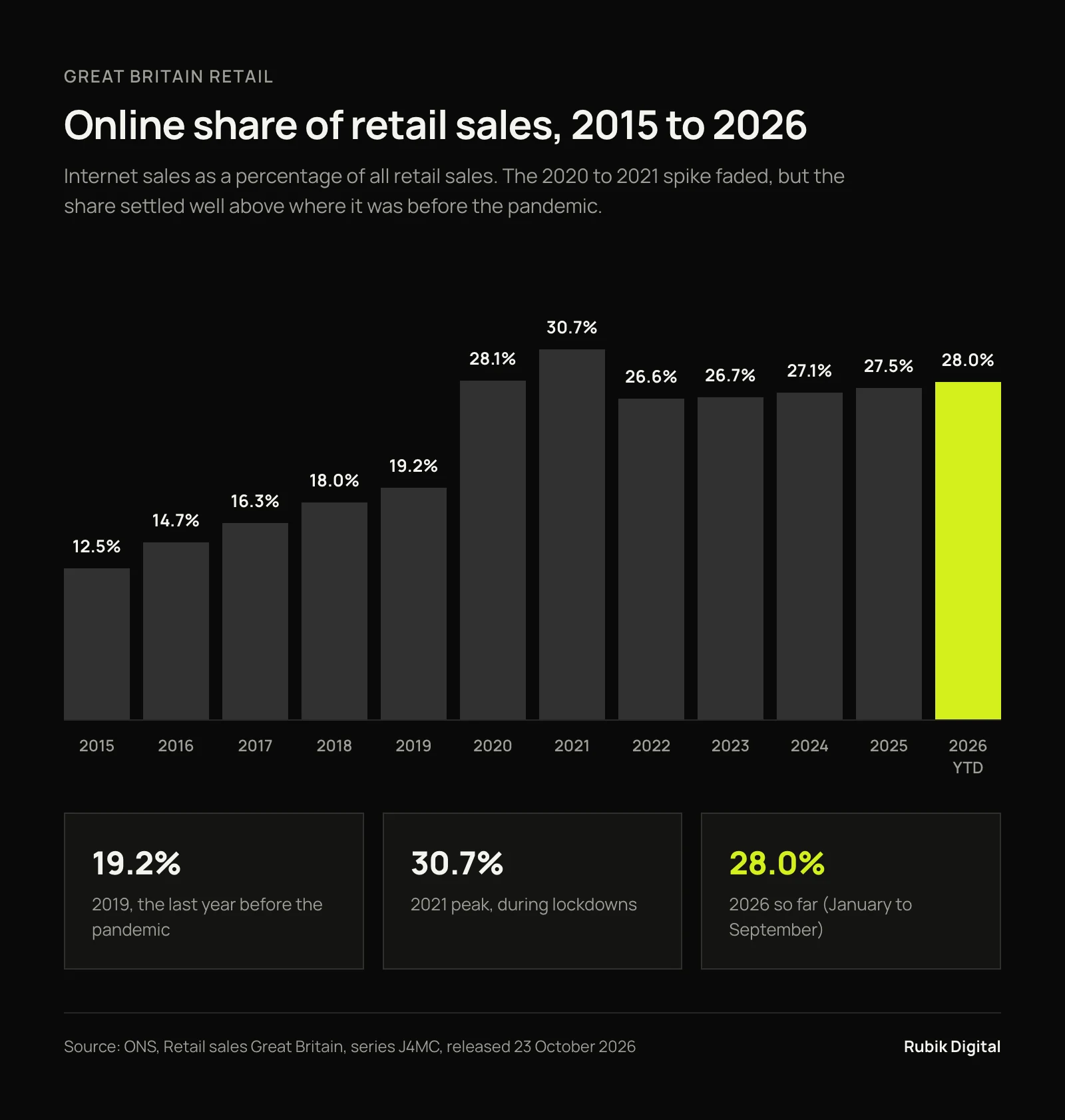
According to the Office for National Statistics, internet sales were 19.2% of retail sales in Great Britain in 2019. Lockdowns pushed the share to 30.7% in 2021. It fell back as shops reopened, but never returned to pre-pandemic levels: it was 27.5% in 2025 and has averaged 28.0% in 2026 so far. Online spending in July to September 2026 was 7.4% higher than a year earlier.
Types of e-commerce
| Type | Who sells to whom | Examples |
|---|---|---|
| B2C (business to consumer) | A business sells to the public | ASOS, Argos, a local bakery's online shop |
| B2B (business to business) | A business sells to other businesses | Wholesale portals, trade suppliers, software for companies |
| D2C (direct to consumer) | A brand sells to customers without retailers in between | Gymshark, many food and beauty brands |
| C2C (consumer to consumer) | Individuals sell to each other through a platform | eBay, Vinted, Facebook Marketplace |
| Marketplace | Many sellers on one platform that takes a fee | Amazon, Etsy, eBay |
| Subscription | Repeat deliveries or access for a regular fee | Meal kits, coffee, software |
| Digital products | Downloads, courses and licences with no shipping | E-books, online courses, templates |
Many businesses mix types: a D2C brand might run its own shop, sell on Amazon and take trade orders from stockists.
How e-commerce works
- The customer finds the product. Through search, social media, an ad, an email or a marketplace.
- They add it to a basket on the product page, choosing size, colour or quantity.
- They check out, entering delivery details and choosing a delivery option.
- They pay. A payment provider such as Stripe, PayPal or Adyen handles the card, Apple Pay or Google Pay transaction and passes the money to the seller, minus a fee.
- The order is processed. The platform updates stock, sends a confirmation email and passes the order to whoever packs it: the business itself, a warehouse or a third-party logistics (3PL) company.
- It is delivered, with tracking updates by email or text.
- After the sale. Returns, refunds, reviews and follow-up emails that bring the customer back.
E-commerce platforms
| Platform type | Examples | Good for | Trade-offs |
|---|---|---|---|
| Hosted (software as a service) | Shopify, BigCommerce, Squarespace, Wix | Getting started quickly with little technical work | Monthly fees, app costs, limits on customisation |
| Self-hosted open source | WooCommerce, Adobe Commerce (Magento), PrestaShop | Full control, content-heavy shops, custom features | You manage hosting, security and updates |
| Headless | A commerce engine with a separate front end | Speed, complex catalogues, several sales channels | Higher build cost and more development |
| Marketplaces | Amazon, eBay, Etsy | Reaching existing buyers without building a site | Fees per sale, competition and less control of the customer relationship |
The right choice depends on catalogue size, how much you want to customise and who will maintain it. WooCommerce suits businesses already on WordPress that publish a lot of content; Shopify suits those who want the technology handled for them. Our headless CMS guide covers the headless option.
How much does an e-commerce website cost?
Setting up a store on a hosted platform with an off-the-shelf theme can cost a few hundred pounds plus your time. A custom-designed e-commerce website from an agency typically costs £6,000 to £20,000, and stores with complex catalogues, integrations with stock or accounting systems, or B2B pricing cost more. Our website development cost guide includes a worked e-commerce budget.
Running costs to plan for:
- Platform fees. A monthly subscription on hosted platforms, or hosting and maintenance on self-hosted ones.
- Payment fees. For example, Stripe's standard rate for UK cards is 1.5% plus 20p per transaction.
- Apps and extensions. Reviews, subscriptions, search and shipping tools often carry their own monthly fees.
- Marketing. Search, social, email and ads, usually the biggest ongoing cost.
- Delivery and returns. Postage, packaging and the cost of returned stock.
Advantages and disadvantages
| Advantages | Disadvantages |
|---|---|
| Open 24 hours, to customers anywhere | Strong competition, including from marketplaces |
| Lower costs than a physical shop | Delivery, returns and payment fees eat into margin |
| Data on what customers view and buy | Customers can't see or try products before buying |
| Easy to test prices, products and offers | Marketing costs to get traffic can be high |
| Can start small and scale | Fraud, security and data protection need managing |
How to start an e-commerce business in the UK
- Validate the product. Check there is demand, what competitors charge and what margin remains after delivery, fees and returns.
- Set up the business. Register with HMRC as a sole trader or set up a limited company with Companies House. Register for VAT once taxable turnover passes £90,000 in a rolling 12 months.
- Choose how you will sell. Your own shop, a marketplace or both.
- Pick a platform and build the shop. Clear product pages, honest photos, delivery costs shown early and a short checkout.
- Set up payments and delivery. Offer cards and wallets such as Apple Pay, and decide whether to fulfil orders yourself or use a 3PL.
- Write your policies. Delivery, returns, privacy and cookies, plus terms and conditions.
- Plan how customers will find you. Search, social, email and ads; see how much SEO costs for budgets.
- Launch, measure and improve. Watch conversion rate, basket abandonment and return rates, and fix the biggest leak first.
The UK rules for selling online
- Cancellation rights. Under the Consumer Contracts Regulations, most online buyers can cancel within 14 days of receiving goods, then have 14 more days to send them back. You must refund within 14 days, including standard delivery.
- Goods must be as described. The Consumer Rights Act 2015 requires goods to be of satisfactory quality, fit for purpose and as described.
- Business details. Your site must show your business name, address and contact details, plus company number and VAT number where you have them.
- Clear pricing. Consumer prices must include VAT, and unavoidable fees must be shown upfront. Since April 2025 the CMA can fine businesses directly for misleading pricing and fake reviews.
- Data and cookies. UK GDPR covers customer data; non-essential cookies, such as most analytics and advertising cookies, need consent.
This is a summary, not legal advice. GOV.UK and the ICO publish detailed guidance.
E-commerce trends to watch in 2026
- Mobile first. Most online shopping now starts on a phone, so a fast mobile checkout matters more than the desktop design.
- Shopping through AI assistants. Tools such as ChatGPT and Google's AI Mode increasingly recommend products, and some let shoppers buy without leaving the chat. Clear product data and structured data help your products appear.
- Social commerce. Buying directly in TikTok, Instagram and YouTube without visiting a website.
- Faster, cheaper delivery and easier returns as the baseline customers expect.
- Retail media. Marketplaces and retailers selling ad space on their own sites.
“Most e-commerce sites don't have a traffic problem; they have a checkout problem. Fixing delivery costs shown too late, or a forced account sign-up, often does more than doubling the ad budget.”
Related: our e-commerce development service and conversion rate optimisation.