Most WordPress agencies promise fast, secure, SEO-friendly websites, and most portfolios look good in screenshots. The differences show up later: when an editor tries to build a page, when an update breaks a form, or when the site you replaced loses half its search traffic. This guide shows how to tell agencies apart before you sign.
Is WordPress still the right choice in 2026?
For most content-led business websites, yes. WordPress powers 39.5% of all websites and 58.2% of sites whose CMS is known, according to W3Techs in October 2026. It remains far ahead of Shopify, Wix and Squarespace.
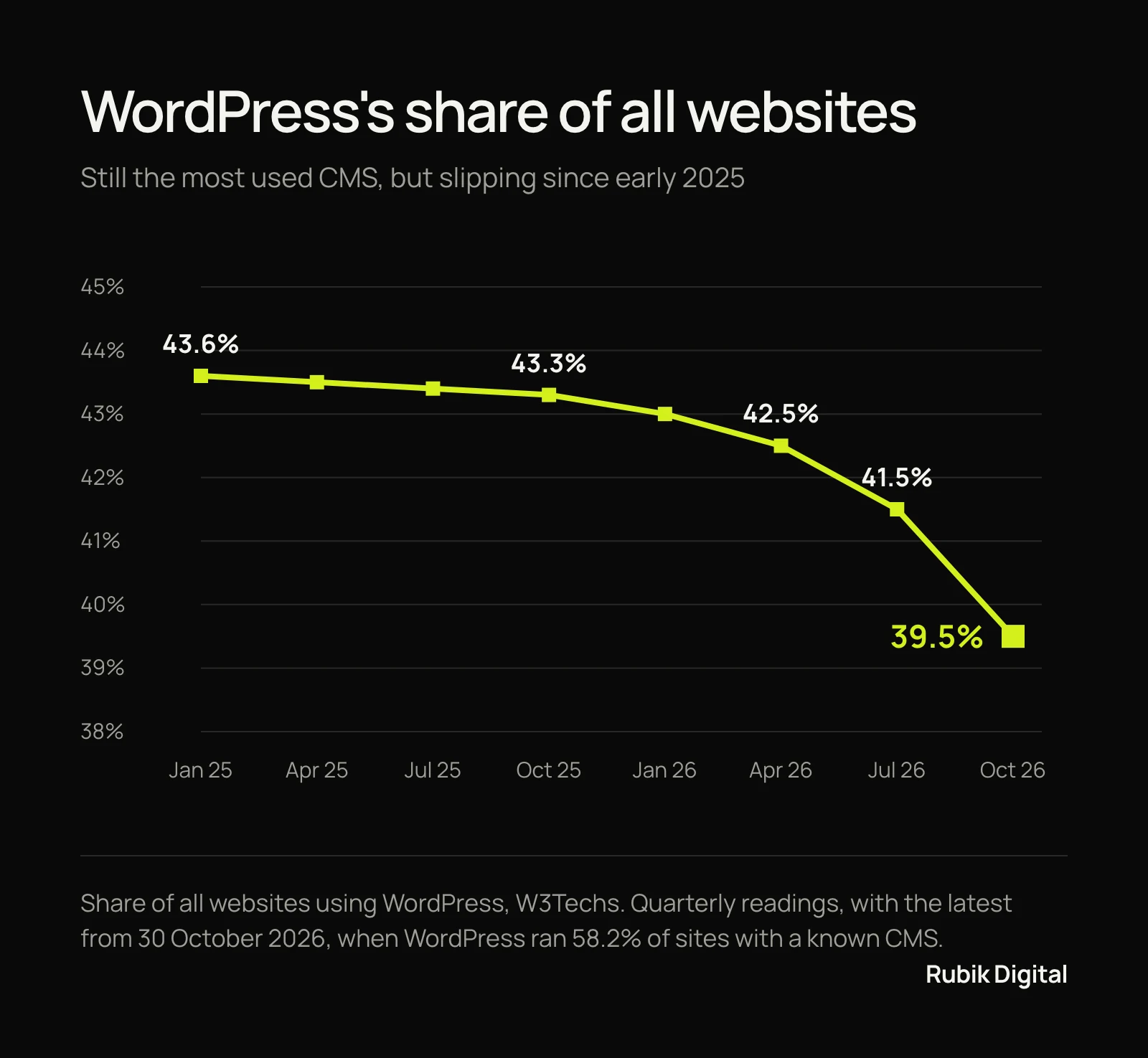
Its share has been slipping, though, from 43.6% in January 2025. More businesses now choose hosted builders for simple sites, and headless platforms for complex ones. That makes it more important to pick an agency that can tell you honestly whether WordPress fits, rather than one that only builds WordPress.
The platform itself is moving quickly. WordPress 7.0 "Armstrong" (20 May 2026) added an AI Client to WordPress core, a Connectors screen for managing AI services and a redesigned dashboard. WordPress 7.1 "Mary Lou" followed on 19 August 2026. An agency should be able to explain what these releases mean for your site, and what they don't.
WordPress is a strong fit when your team publishes often, needs to build pages without a developer, and relies on integrations such as CRM, forms and e-commerce. It is a weaker fit for app-like products, or for sites with strict security and governance needs. Our comparisons of headless CMS vs WordPress and WordPress vs Webflow cover the alternatives.
What a good WordPress agency does
- Discovery first. Works out goals, audiences, content and integrations before designing anything.
- A theme built for your content. Custom blocks and patterns that match how your team publishes, instead of a bought theme or a heavy page builder bent into shape. Page builders are popular (W3Techs finds Elementor on 31.5% of WordPress sites), but they often add weight and lock your content into one plugin.
- Proper engineering. Version control, a staging site, code review, and deployments that do not involve editing files on the live server.
- Few plugins, well chosen. Each plugin is another thing to update and another way in for attackers.
- SEO built in. Clean templates, editable titles and descriptions, structured data and a redirect plan when replacing an existing site.
- Performance and accessibility. Key templates tested on mobile against Core Web Vitals and for keyboard and screen-reader use.
- Care after launch. Tested updates, backups, monitoring and someone who answers when something breaks.
How to judge a WordPress agency
Look at live sites, not screenshots
Open three or four sites from their portfolio on your phone. Run the homepage through PageSpeed Insights. Check they still look and work as shown. Ask whether you can speak to one of those clients.
Ask to see the editing experience
Ask for a demo of the admin on a site they built. Can an editor create a new page from approved blocks without breaking the design? If every change needs a developer, the site will go stale.
Find out who does the work
Some agencies design in-house and outsource development. That can work, but you should know, and you should know who fixes things after launch.
Check the process
Look for discovery, content planning, design, development on staging, testing, launch and a defined support period. Ask how long each stage takes and what you need to provide. Our guide to website development timelines shows typical durations.
Questions to ask before you hire
| Question | A good answer sounds like |
|---|---|
| Who will build the site? | Named people, and whether any work is outsourced |
| Custom theme or page builder? | A reasoned choice for your content and editors, not a default |
| Which plugins will we depend on? | A short list, each with a reason and a licence owner |
| How do you protect SEO when replacing our site? | A redirect map, content inventory and launch checks, with someone accountable |
| How do you test updates? | Staging, backups before changes, and checks on forms and key pages after |
| Who owns the code, domain, hosting and accounts? | You do, with admin access from day one |
| What happens after launch? | A clear support plan, response times and monthly cost |
| How do you measure success? | Enquiries, sales or other goals agreed up front, not just launch on time |
Red flags
- Guaranteed rankings or "page one in 30 days".
- A price given before anyone has asked about your content, integrations or current site.
- No mention of redirects when you are replacing an existing site.
- The agency keeps the domain, hosting or admin accounts in its own name.
- Every site in the portfolio uses the same bought theme.
- No support offer, or support that only covers "hosting".
What a WordPress agency costs in the UK
| Project | Typical cost |
|---|---|
| Small business website | £3,000 to £8,000 |
| Custom marketing website | £8,000 to £20,000 |
| Complex business platform with integrations | £20,000 to £50,000 |
| Enterprise or multisite WordPress | £50,000+ |
| Ongoing care for a business site | £150 to £500 a month |
The biggest cost drivers are the number of templates, how much content needs writing or migrating, integrations, and the level of support you need afterwards. Our guides to website development costs and website maintenance costs break these down further.
Agency, freelancer or in-house?
| Option | Best for | Watch out for |
|---|---|---|
| Freelancer | Small sites and well-defined tasks | Holidays, illness and capacity; design or SEO gaps |
| Agency | Business-critical sites needing design, build, SEO and support | Who actually does the work; minimum project sizes |
| In-house developer | Large sites with constant change | One person covering design, code, security and hosting |
WordPress support agencies
If you already have a WordPress site, you may need a support agency rather than a rebuild. Look for tested updates rather than blind auto-updates, off-site backups that are restored as a test, uptime and security monitoring, and a named person who fixes problems. Our WordPress support service and our guide to managed WordPress hosting cover what that should include.
“The best test of a WordPress agency is a year after launch: can your team still edit the site without help, is it still fast, and does someone pick up the phone when an update goes wrong?”
How we approach WordPress
We build WordPress sites around your brand and content rather than a bought theme, with custom blocks your team can use without a developer, as few plugins as possible, and search, speed and enquiry tracking planned from the start. When WordPress is not the right fit, we will say so. See our WordPress development page for how we work, or our website development service if you have not chosen a platform yet.