
Google handles about nine in every ten searches worldwide and Bing about one in twenty. That gap is real, but it hides two things that matter more to a business website in 2026. On desktop computers Bing's share is roughly three times higher than its headline figure, and Bing's index now feeds Microsoft Copilot and several other search engines and AI tools.
This guide compares the two on the questions people actually ask: how they differ, whether Bing is any good, how each ranks pages, who uses them and whether Bing is worth your time. The market share figures are StatCounter's for September 2026, and everything else comes from Google's and Microsoft's own documentation.
Bing vs Google: the short answer
- Google is far bigger: it had 89.9% of searches worldwide and 91.4% in the UK in September 2026. Bing had 5.3% and 6.1%.
- Bing is a desktop search engine: it had 18.4% of UK desktop searches but only 0.4% of UK mobile searches.
- Both now answer with AI: Google with AI Overviews and AI Mode, Bing with Copilot Search, which it now labels "AI Overview" and also offers through an AI Mode tab.
- They rank pages on the same foundations: crawlable pages, clear content, good links and trust. The practical differences are in the tools each gives site owners, not in hidden ranking signals.
- You should optimise for both: the extra work for Bing is small. Verify your site in Bing Webmaster Tools, submit your sitemap and switch on IndexNow.
| Bing | ||
|---|---|---|
| Owner | Google, part of Alphabet | Microsoft |
| Launched | 1998 | 2009, replacing Live Search |
| Share of searches worldwide (Sept 2026) | 89.9% | 5.3% |
| Share of searches in the UK (Sept 2026) | 91.4% | 6.1% |
| Share of UK desktop searches (Sept 2026) | 75.9% | 18.4% |
| AI answers in search | AI Overviews and AI Mode | Copilot Search, labelled AI Overview, and an AI Mode tab |
| AI assistant | Gemini | Microsoft Copilot |
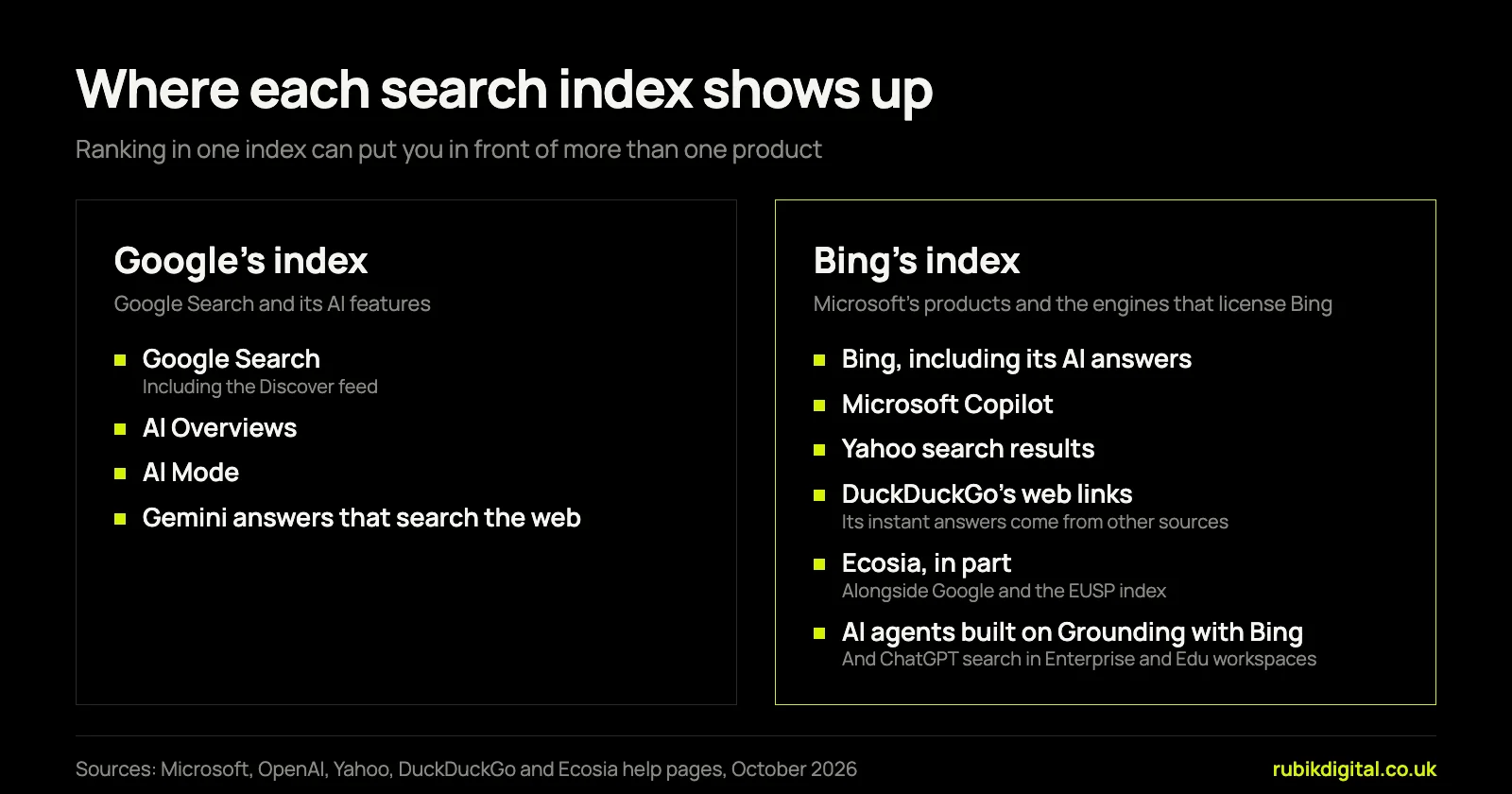
| Other products using its results | Google's own products | Copilot, Yahoo, DuckDuckGo's web links and, in part, Ecosia |
| Default search in | Chrome, Android, and Safari on iPhone through a paid deal with Apple | Windows search and Microsoft Edge |
| Getting new pages found fast | XML sitemaps and Search Console's URL Inspection tool | IndexNow, plus XML sitemaps |
| Free tools for site owners | Google Search Console | Bing Webmaster Tools |
| AI reporting for site owners | Impressions in AI Overviews and AI Mode | Citations in Copilot and Bing's AI answers, with the queries behind them |
| Advertising platform | Google Ads | Microsoft Advertising |
What is the difference between Google and Bing?
Both are general search engines. Each runs its own crawler (Googlebot and Bingbot), builds its own index of the web and ranks pages with its own systems. Neither uses the other's results. The real differences are who owns them, where they are the default, how many people use them and which other products draw on their index.
Google is owned by Alphabet. It is the default search engine in Chrome and on Android phones, and in Safari on the iPhone through a long-running payment to Apple. In September 2025 a US federal judge ruled that Google can keep paying for that placement but can no longer sign exclusive distribution contracts. Google and the US Department of Justice have both appealed, and the appeal court could hear arguments from December 2026. Those default deals are the main reason Google has around 98% of UK mobile searches.
Bing is owned by Microsoft. It is the default in Windows search and in the Edge browser, which is why its share on desktop computers is so much higher than on phones. Microsoft also licenses Bing's results to other search engines: Yahoo's results come from Bing, DuckDuckGo takes most of its traditional web links from Bing, and Ecosia mixes Bing with Google and the European EUSP index depending on where you are.
Google and Bing results pages now look alike
We searched for the same question on both engines from the UK on 28 October 2026. Both opened with an AI-written summary labelled "AI Overview", both showed the sources it drew on in a panel on the right, and both offered an "AI Mode" tab for a longer, conversational answer. The ordinary list of links started below the AI summary on both.
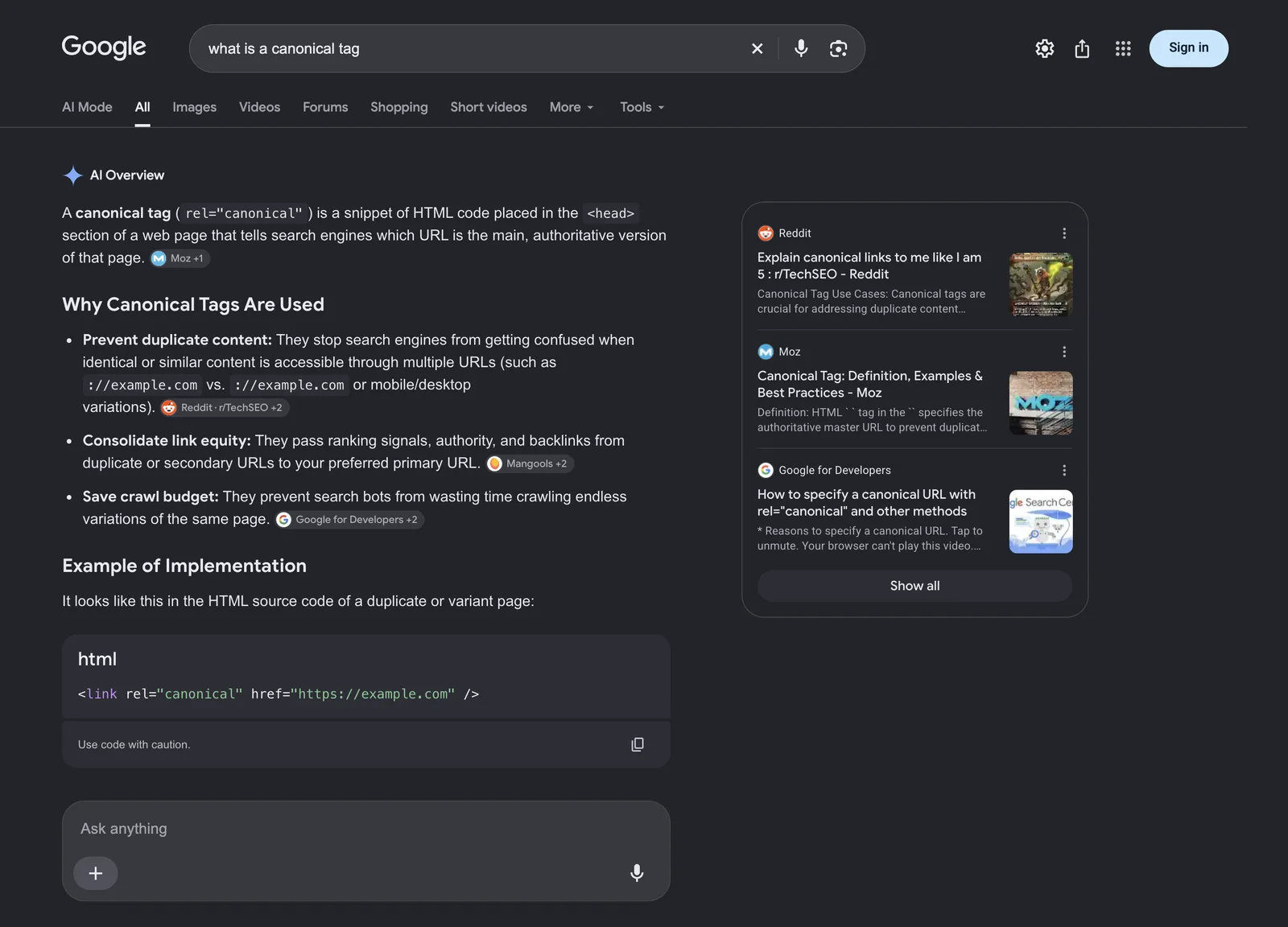
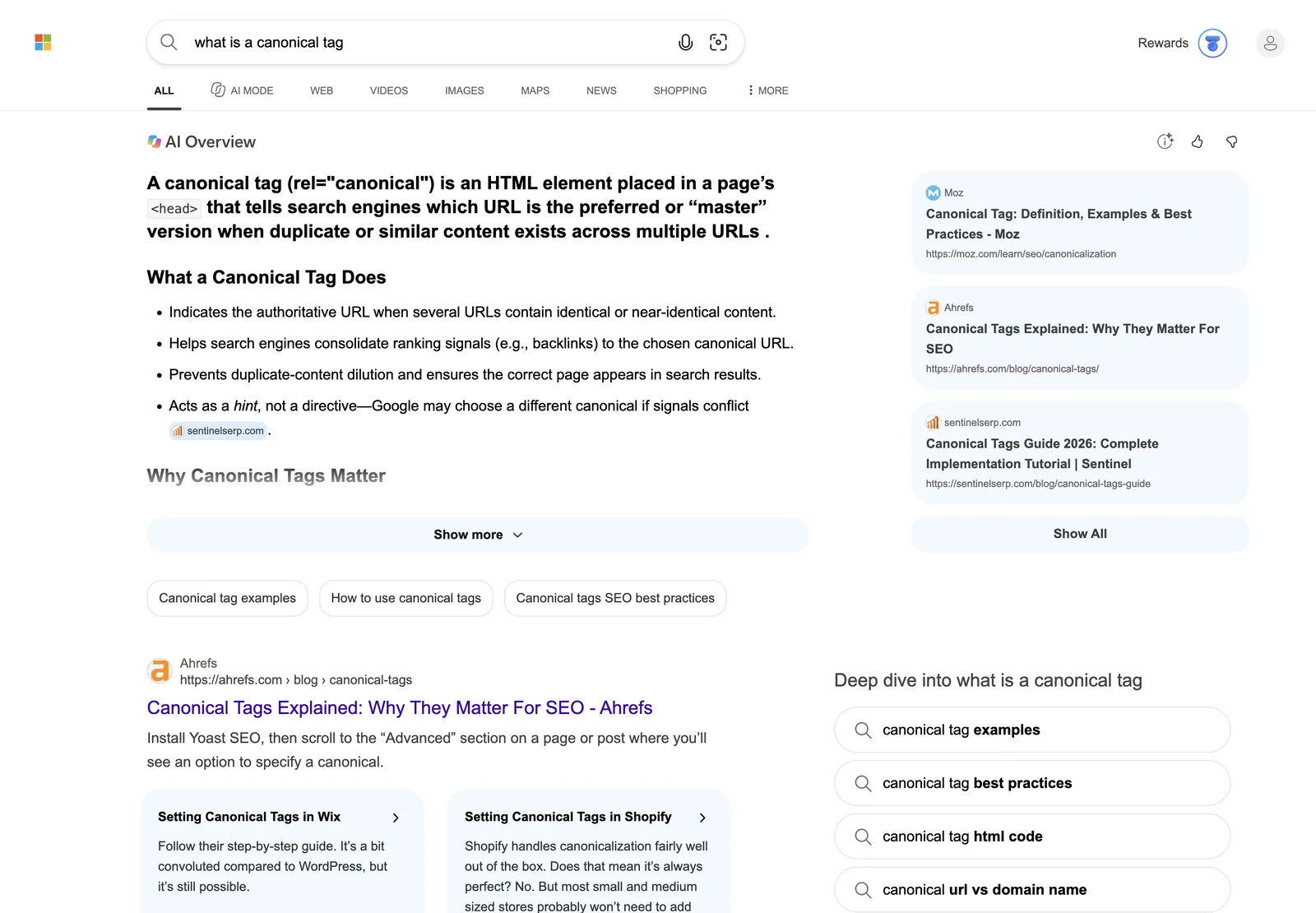
The two cited overlapping but different sources for the same question, which is the point that matters for a website. Each engine's AI answers are built from its own index, so a page that ranks well in one is not automatically cited by the other. Google launched AI Mode in the UK in July 2025, and Microsoft launched Copilot Search in Bing in April 2025.
Is Bing a good search engine?
Yes, for most everyday searches. Bing runs a full independent index of the web, its AI answers cite their sources clearly, and Microsoft Rewards pays points for using it. In our experience, its results for common informational and commercial searches are usually close to Google's.
Google is stronger in three places:
- Local searches. Google's map results draw on Google Business Profiles and the reviews customers leave on them. Bing has its own listings, Bing Places, but they rely on businesses setting up and maintaining a second profile.
- Phones. Google is built into Android and the iPhone's default browser, so its mobile results and features get far more use and testing.
- Very specific or very new searches. Google's index is larger, so rare questions and breaking news are more likely to be covered there.
Is Bing better than Google in 2026?
For most searchers, no. Google's index is larger, its local data is far richer and nine in ten people already use it. But that is the wrong question for a business. Your buyers do not choose one engine for you, and nearly a fifth of UK desktop searches go through Bing, the default search engine on Windows PCs. If you sell to other businesses, many of your buyers will be searching from a Windows PC at work.
How Bing's ranking algorithm differs from Google's
Neither company publishes its ranking algorithm. Both publish guidelines, and the most useful comparison comes from what they say. Bing rewrote its Webmaster Guidelines for the Copilot era, and they start by saying that the same SEO basics decide whether a page ranks in Bing and whether it is used in Copilot's answers. Google says the same about AI Overviews and AI Mode, which are built on its core Search systems.
Where Bing's guidelines are more specific than Google's:
- IndexNow. Bing asks sites to notify it whenever a URL is added, updated or removed, and prefers a steady stream of notifications to large batches. Google does not support IndexNow.
- Answers near the top. Bing tells you to put essential information early and avoid long introductions, and to make facts explicit so a page can be understood without outside context.
- One topic per page. Pages focused on a single topic, with matching titles and headings, are more likely to be used in its AI answers.
- Directives that affect AI answers. NOARCHIVE keeps a page's content out of Copilot answers, and NOCACHE limits Copilot to the URL, title and snippet. Many sites set these without knowing what they now do.
- Redirects. Use 301s for permanent moves, use 302s only for changes shorter than two days, and use redirects rather than canonical tags when content moves.
Several Bing "ranking factors" repeated in older articles are not in Microsoft's current guidance. The guidelines do not list social media shares as a ranking signal, and they class "artificial social promotion schemes" as abuse. There is no documented preference for exact-match domains or for .gov and .edu sites. Spend the time on content and technical health instead, which both engines reward.
Bing vs Google market share in 2026
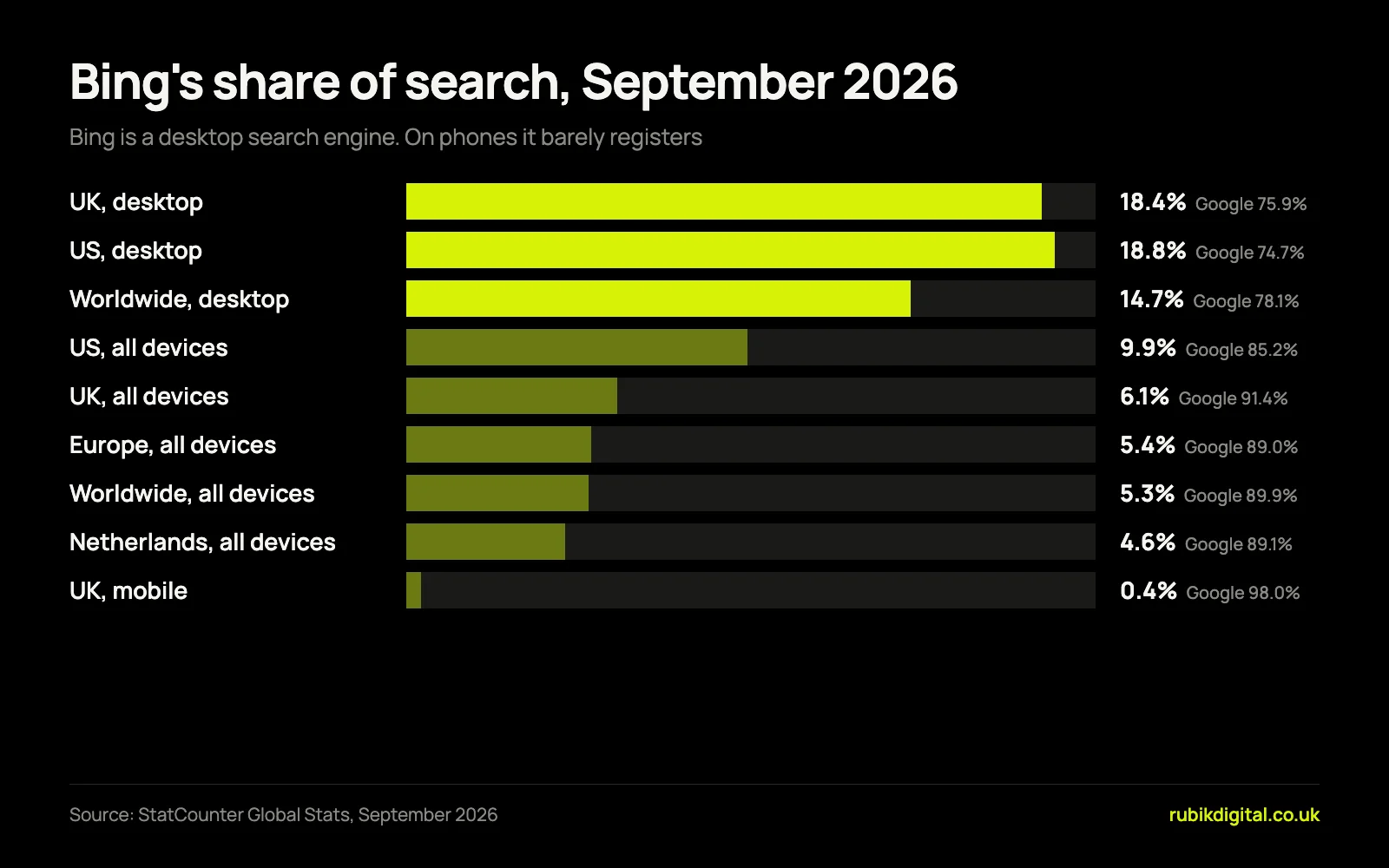
In September 2026, Google had 89.9% of searches worldwide and Bing had 5.3%, according to StatCounter. Yahoo, which uses Bing's results, had 1.4%, Yandex 1.3% and DuckDuckGo 0.7%. The split changes sharply by device.
| Market (September 2026) | Bing | |
|---|---|---|
| Worldwide, all devices | 89.9% | 5.3% |
| UK, all devices | 91.4% | 6.1% |
| US, all devices | 85.2% | 9.9% |
| Europe, all devices | 89.0% | 5.4% |
| Netherlands, all devices | 89.1% | 4.6% |
| Worldwide, desktop | 78.1% | 14.7% |
| UK, desktop | 75.9% | 18.4% |
| US, desktop | 74.7% | 18.8% |
| UK, mobile | 98.0% | 0.4% |
StatCounter measures page views that arrive from each search engine across the sites using its tracking code, so treat these as a guide to direction rather than an exact count of searches. Monthly figures also move around, which is why we compare a full year below.
Is Bing's market share growing?
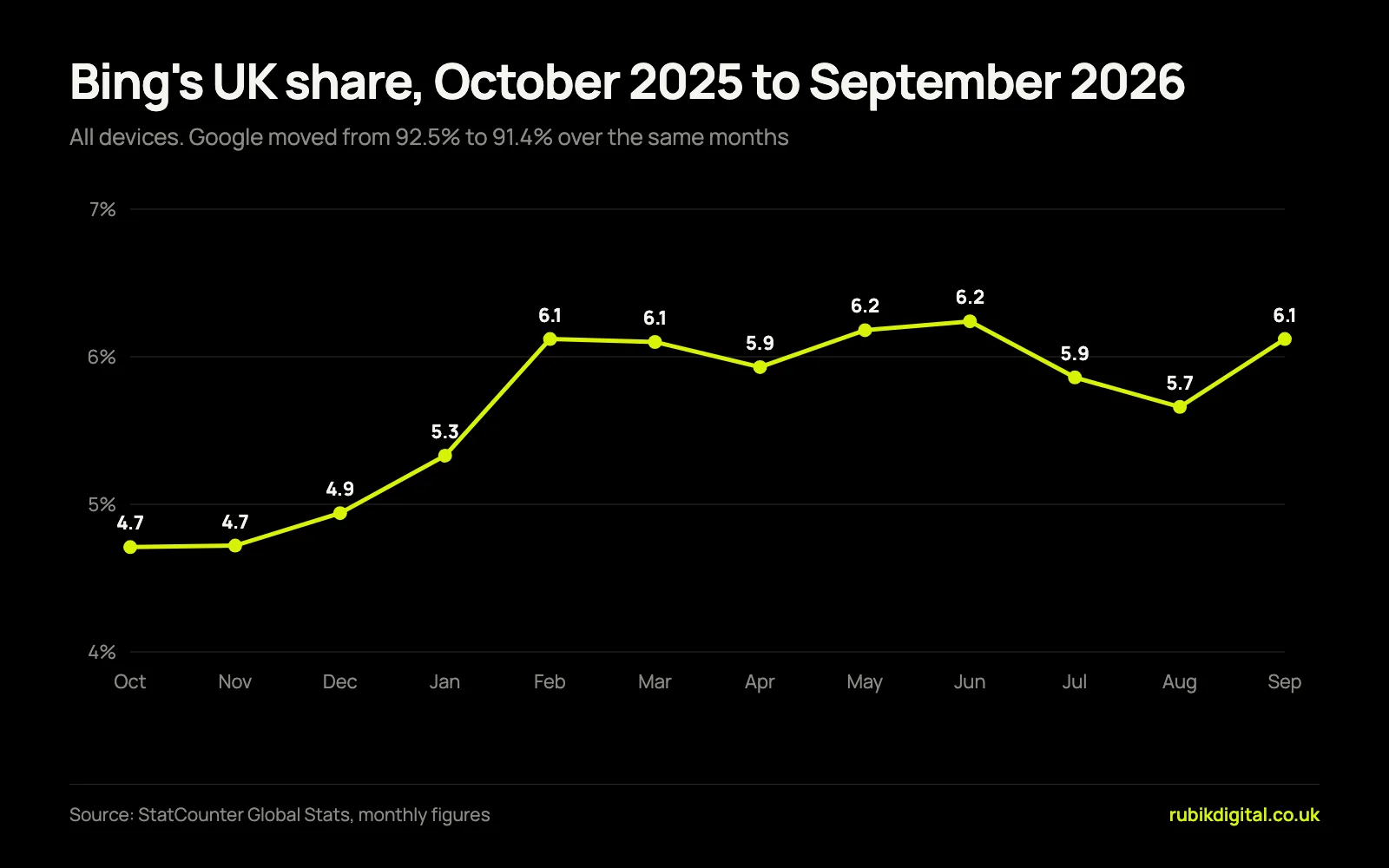
Slowly. Bing's UK share rose from 4.7% in October 2025 to 6.1% in September 2026, while Google's fell from 92.5% to 91.4%. Worldwide, Bing went from 4.3% to 5.3% over the same months. Most of the UK rise came between December and February and has held since.
Bing market share in Europe and the Netherlands
Across Europe Bing had 5.4% in September 2026, almost exactly its worldwide share, with Yandex third at 2.4% because of its use in Russia and nearby markets. In the Netherlands Bing had 4.6%, slightly below the European figure, while DuckDuckGo had 1.5%, twice its worldwide share.
Why Bing matters for AI search
The strongest reason to care about Bing in 2026 is not bing.com. It is that Microsoft now sells Bing's index as the grounding source for AI: Copilot's web answers come from it, and in August 2025 Microsoft retired its public Bing Search APIs and pointed developers to Grounding with Bing Search, which feeds Bing results into AI agents built on Microsoft's platform.
Does ChatGPT use Bing?
Partly, and less than is often claimed. OpenAI's help centre says ChatGPT search in Enterprise and Edu workspaces sends queries to Bing. For other accounts OpenAI says only that it uses third-party search providers alongside content from its partners. Independent tests published in 2026 by the SEO consultancy Resoneo found that most results for free users came from an index OpenAI runs itself, while about three quarters of the results in paid accounts' thinking mode were scraped from Google.
So being in Bing will not on its own get you into ChatGPT's answers. Being well indexed in both Google and Bing, and letting AI crawlers reach your site, covers most of the routes in. Our study of 1.4 million crawler requests shows how much of that traffic now comes from AI companies rather than search engines.
Bing tells you more about AI citations than Google does
Since February 2026, Bing Webmaster Tools has had an AI Performance report showing how often your pages are cited in Copilot, Bing's AI answers and some partner AI products, which pages are cited and the grounding queries behind them. In June 2026 Microsoft added Intents, Topics, Citation Share and a Compare view.
Google's equivalent, the generative AI performance report in Search Console, reached every website on 31 August 2026. It shows impressions in AI Overviews and AI Mode by page, country and device, but not the queries or the clicks. Used together, the two free reports give you a better picture than either alone, and we compare them with the paid options in our guide to AI visibility tools.
How to optimise for Bing and Google at the same time
Most of the work is shared. These are the steps that cover both, with the Bing-specific ones that take minutes rather than days.
- Verify your site in both tools. Set up Google Search Console first, then Bing Webmaster Tools, which can import your verified sites from Search Console. See our Google Search Console guide if you are starting from scratch.
- Submit the same XML sitemap to both. List only canonical URLs and keep the lastmod dates accurate. Both engines use them to decide what to recrawl.
- Switch on IndexNow. WordPress, Shopify, Wix, Drupal and many other platforms support it natively or through a plugin. On a custom site it is one request per change, for example to https://api.indexnow.org/indexnow?url=https://www.example.co.uk/new-page&key=your-key, with the key file published at the root of your domain. One notification reaches Bing, Yandex, Seznam, Naver and the other participating engines.
- Make sure Bingbot can crawl and render your pages. Check robots.txt, firewall and bot-protection rules, and avoid hiding the main content behind JavaScript that has to run before anything appears.
- Answer the question at the top of the page. Both engines' AI answers lift clear, self-contained statements. Lead with the answer, then explain.
- Check your snippet directives. NOARCHIVE, NOCACHE and nosnippet now change whether your content can appear in AI answers, not just in the results snippet.
- Claim Bing Places for Business. If you serve local customers, Bing Places can import your Google Business Profile, so the listing takes minutes.
- Track both. Compare clicks and impressions in Search Console and Bing Webmaster Tools each month, and review both AI reports. A technical SEO review will catch crawl issues that hurt you in both.
The bottom line
Google is still where nine in ten searches start, so it deserves most of your attention. But Bing is not a rounding error: it has nearly a fifth of desktop searches in the UK and US, its share has grown over the past year, and its index feeds Copilot, Yahoo, DuckDuckGo and a growing number of AI tools. Optimising for Bing takes an afternoon on top of good Google SEO, and it is one of the cheapest ways to widen your AI search visibility.