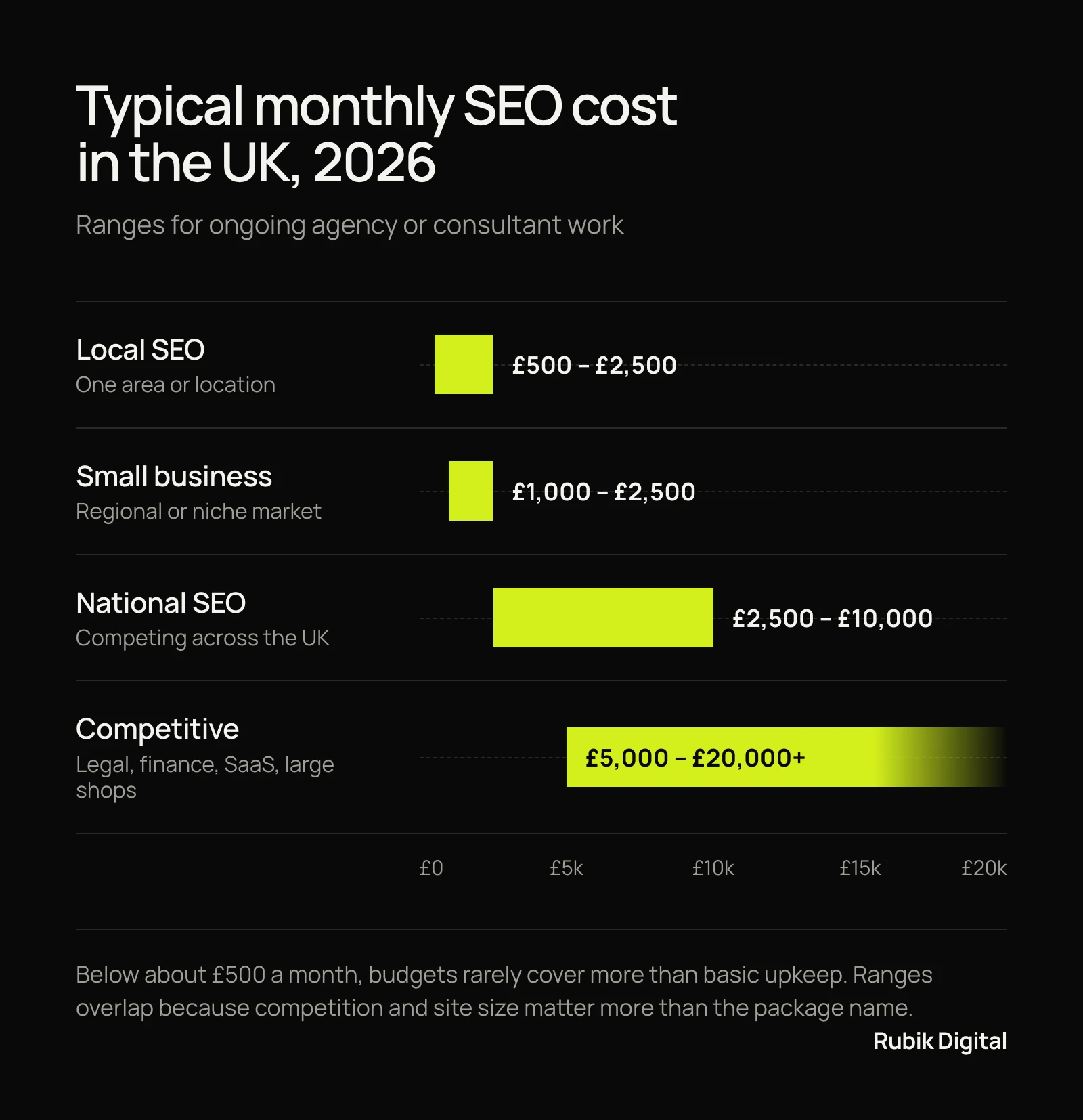
SEO in the UK typically costs between £1,000 and £5,000 a month. Local SEO for one area usually costs £500 to £2,500 a month, national campaigns £2,500 to £10,000, and competitive sectors £5,000 to £20,000 or more. A one-off SEO audit costs £1,000 to £5,000, and freelance consultants charge roughly £30 to £300 an hour.
Those ranges are wide because SEO is priced by the work needed, not by a fixed product. This guide shows what each budget usually buys, how prices change by business size and industry, which pricing models agencies use, and how to compare two quotes that look nothing alike.
UK SEO prices at a glance (2026)
| Type of SEO | Typical UK price | Best for |
|---|---|---|
| Local SEO (one area) | £500 – £2,500 a month | Trades, clinics, local services |
| Small business SEO | £1,000 – £2,500 a month | Regional or niche markets |
| National SEO | £2,500 – £10,000 a month | Businesses competing across the UK |
| Competitive or enterprise SEO | £5,000 – £20,000+ a month | Legal, finance, SaaS, large ecommerce |
| One-off SEO audit | £1,000 – £5,000 | Finding what holds a site back |
| Technical SEO project | £2,000 – £10,000 | Migrations and major fixes |
| Freelance SEO consultant | £30 – £300 an hour | Advice and smaller tasks |
A small budget can still work for a local business in a quiet market. It will not move rankings in a sector where competitors spend ten times as much, which is why the same service can cost £800 a month for one business and £8,000 for another.
What drives the cost of SEO
Agencies price SEO by the hours a campaign needs. Four things decide how many hours that is.
- Competition. Ranking for "plumber in Woking" takes far less work than ranking for "remortgage" or "CRM software". The more established the sites above you, the more content and links you need to overtake them.
- Site size and health. A ten-page brochure site can be audited in a day. A 20,000-page shop with filters, duplicate pages and a slow template needs ongoing technical work before content can help.
- Content gap. If competitors have a guide for every question your buyers ask and you have a homepage and a contact page, most of the budget goes on writing.
- Authority gap. Sites that other trusted sites link to and mention tend to rank and get cited in AI answers. Earning those mentions through digital PR is slow, skilled work and often the most expensive part.
If you are unsure where your site stands on any of these, an SEO audit is the cheapest way to find out before committing to a monthly budget. Our guide to how to do an SEO audit shows what a proper one covers.
What each budget usually buys
Hours are the honest way to compare budgets. At UK agency rates, £1,000 a month buys roughly 7 to 13 hours of work, £2,500 roughly 17 to 33 hours, and £5,000 roughly 33 to 66 hours. Our SEO packages guide breaks each level down in detail.
| Monthly budget | What you should get | What it cannot cover |
|---|---|---|
| £500 – £1,000 | Google Business Profile, local citations, fixes to key pages, monthly checks | Regular content, link building, national terms |
| £1,000 – £2,500 | Technical fixes, 1–3 optimised pages or articles a month, local or niche link building | Fast growth in a crowded national market |
| £2,500 – £5,000 | Ongoing technical work, 3–5 pieces of content a month, outreach, conversion tracking | Large digital PR campaigns |
| £5,000+ | A full programme: technical, content clusters, digital PR, AI search visibility, monthly strategy | Nothing in principle; the question becomes return |
SEO pricing by business size
| Business size | Typical monthly budget | Where the money goes |
|---|---|---|
| Small business (one location) | £500 – £2,500 | Local search, key service pages, reviews |
| Growing business | £2,500 – £5,000 | Content, technical fixes, authority building |
| Established or enterprise | £5,000 – £20,000+ | National or international SEO at scale |
A common rule of thumb is to spend 5 to 10% of the marketing budget on SEO. A better test is the value of a new customer. If one client is worth £20,000 a year, a £3,000 a month campaign only needs to win two clients a year to pay for itself.
SEO pricing by industry
Industry changes the price because it changes the competition and the rules. Finance and health pages are held to a higher standard of trust by Google, and finance content often needs compliance sign-off, which adds time.
| Industry | Typical monthly cost | Why |
|---|---|---|
| Legal | £3,000 – £10,000+ | High-value leads, strong competition |
| Finance and insurance | £3,000 – £12,000+ | Trust requirements and compliance review |
| SaaS and tech | £4,000 – £15,000+ | Content-heavy, long buying cycles |
| Ecommerce | £2,000 – £8,000+ | Category and product pages at scale |
| Healthcare and dental | £2,000 – £6,000 | Local search plus trust signals |
| Property | £2,000 – £7,000 | Location-based competition |
| Local trades | £800 – £2,500 | Mostly local search |
If you work in one of the higher-cost sectors, see our guides to SEO for financial services and our SaaS SEO service.
Common SEO pricing models
Monthly retainer
Most SEO is sold as a monthly retainer, because rankings come from steady work over months rather than a single fix. Retainers usually run from £1,500 to £5,000 a month for growing businesses. Ours typically start around £1,500 a month through our monthly SEO management service, with a fixed proposal after a discovery call.
Project pricing
Some work has a clear start and end: an audit, a site migration or a technical clean-up. These are usually priced as projects, from about £1,000 for a small audit to £20,000 for a complex migration. A website migration is the project where cutting corners costs most, because lost rankings can take months to recover.
Hourly consulting
| Provider | Typical hourly rate |
|---|---|
| Junior SEO freelancer | £30 – £60 |
| Experienced SEO consultant | £75 – £150 |
| Specialist consultant (technical, migrations) | £150 – £300+ |
Hourly work suits teams that do the SEO themselves and want an expert to check their plan or fix one problem.
Performance-based pricing
Some providers charge only when you rank or get leads. It sounds safe, but it rewards whatever is easiest to measure, such as rankings for low-value terms, and it can push providers towards risky link building. If you consider it, define the target in leads or revenue, not positions.
SEO agency vs freelancer vs in-house
| Option | Typical cost | Strengths | Watch for |
|---|---|---|---|
| Freelancer | £500 – £3,000 a month | Lower cost, direct contact | One person's skills and capacity |
| Agency | £1,500 – £10,000+ a month | Technical, content and PR specialists in one team | Who actually does the work |
| In-house hire | Salary plus tools, often £45,000 – £90,000+ a year in total | Deep knowledge of your business | One hire rarely covers technical, content and outreach |
An in-house SEO also needs tools such as Ahrefs or Semrush, which cost from a few hundred pounds a month, plus developer and writer time. Many businesses end up with a hybrid: an in-house marketer who owns the plan and an agency for the specialist work.
“The cheapest SEO is the work you never have to redo. We see more budget lost to a botched migration or a bought link profile than to any agency fee.”
Hidden costs that quotes often leave out
- Developer time. An audit is only useful if someone fixes what it finds. If your agency cannot change the site, budget for your developer.
- Content production. Some retainers include strategy but not writing. Check how many pieces a month are included and who writes them.
- Tools. Most agencies include their tools. Freelancers sometimes pass the cost on.
- Digital PR. Earning press coverage is often priced separately, from £2,000 a month or per campaign.
- Minimum terms. Six or twelve-month contracts are common. Ask what happens if results are poor at month four.
How to compare SEO quotes
Two quotes for the same business can differ by thousands because they include different work. Ask each provider the same questions:
- How many hours a month does this buy, and who does the work?
- What exactly happens in the first three months?
- How many pages or articles a month are included, and who writes them?
- How will you earn links, and can you show examples?
- Will we own the accounts, content and data if we leave?
- How will you report on leads and revenue, not just rankings?
Be wary of guaranteed first-page rankings, packages that promise a fixed number of backlinks, and reports that only show rankings for terms nobody searches. Our guide to choosing an SEO agency covers the warning signs in more detail.
Does AI search change what SEO costs?
Not as a separate fee. Google's guidance says there are no additional requirements to appear in AI Overviews or AI Mode: a page needs to be indexed and eligible to show a snippet, and the usual SEO best practice applies. What has changed is where the hours go.
- More time on clear, direct answers near the top of key pages.
- More time on structured data that matches what the page shows.
- More time on being mentioned by trusted sites, which matters for ChatGPT, Copilot and Perplexity as well as Google.
- Tracking AI referrals separately so you can see what they are worth.
If AI answers are a priority, our AI search visibility service covers that work as part of a wider SEO plan.
How long SEO takes to pay back
| Timeline | What usually happens |
|---|---|
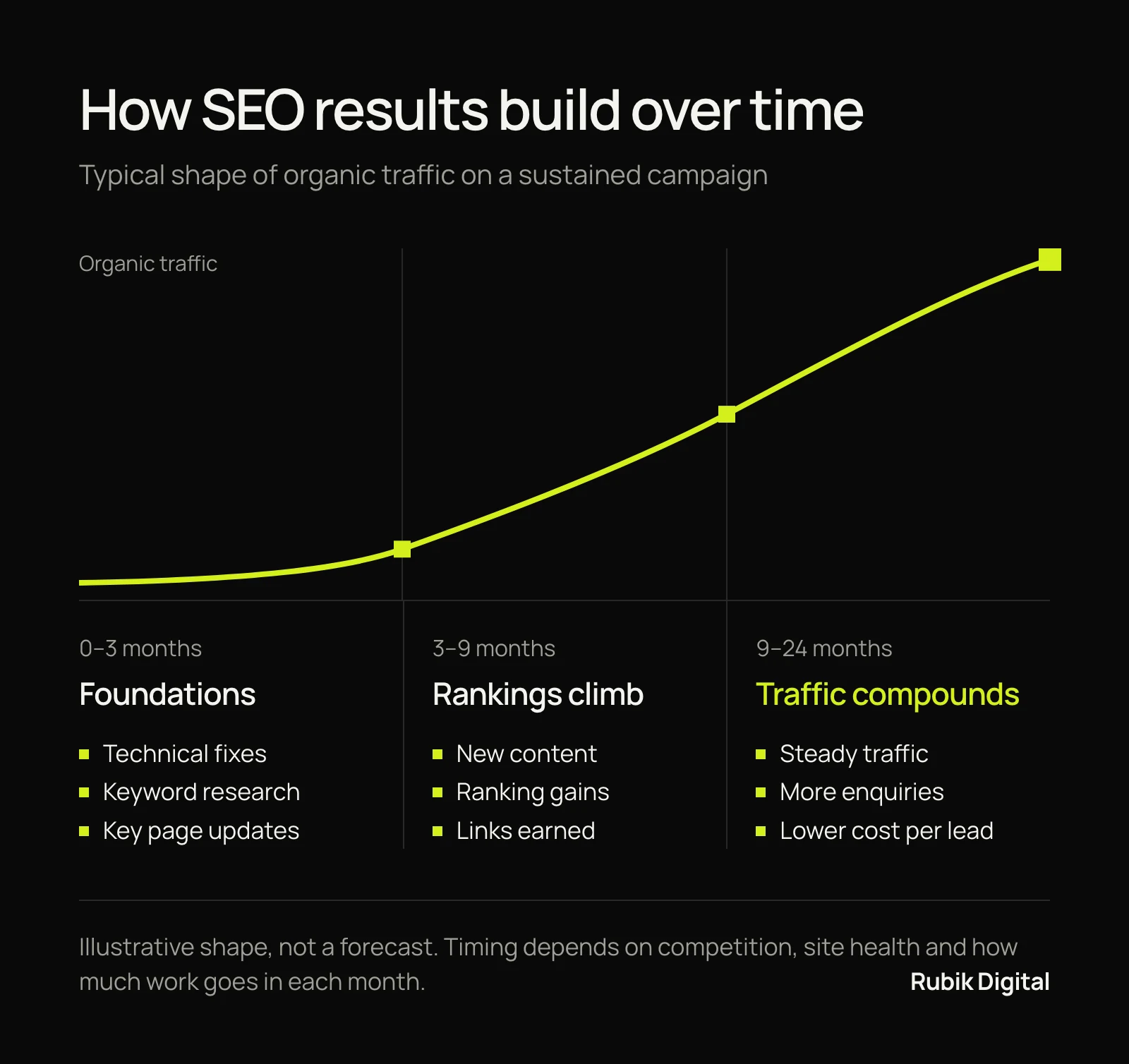
| 0–3 months | Audit, technical fixes, keyword research, first page improvements |
| 3–6 months | Early ranking gains on less competitive terms |
| 6–12 months | Noticeable growth in organic traffic and enquiries |
| 12+ months | Compounding results as content and links build up |
How to work out what SEO is worth to you
Before choosing a budget, estimate what extra organic visitors are worth. You need four numbers: extra monthly visitors, the share who enquire, the share of enquiries who buy, and the value of a customer.
| Step | Illustrative figure |
|---|---|
| Extra organic visitors a month | 1,000 |
| Enquiry rate | 1.5% (15 enquiries) |
| Enquiries that become customers | 20% (3 customers) |
| Value of a customer | £3,000 |
| Monthly value of the extra traffic | £9,000 |
| Monthly SEO spend | £2,500 |
These are illustrative figures, not a client result. Use your own conversion rate and customer value from analytics or your CRM. If the numbers only work with wildly optimistic traffic, the budget is too high or SEO is the wrong channel for now.
Is SEO worth the cost?
SEO is usually worth it when customers search for what you sell, a customer is worth enough to cover months of work, and you can wait six to twelve months for results. Unlike paid search, traffic does not stop when spending pauses, and good pages keep earning visits for years.
| Factor | SEO | Paid search (Google Ads) |
|---|---|---|
| How you pay | Ongoing monthly work | Per click |
| Time to results | Months | Immediate |
| Cost per lead over time | Tends to fall | Tends to rise with competition |
| When spending stops | Traffic declines slowly | Traffic stops |
It is less suited to brand-new products nobody searches for yet, or businesses that need leads this month. In those cases, paid search can carry you while SEO builds. Our SEO and organic growth team can tell you honestly which fits, and we work with businesses across the UK from our bases serving Surrey and London.