AI visibility is how often, and how accurately, AI assistants mention your business and cite your website when people ask questions you could answer. It covers ChatGPT, Gemini, Perplexity, Claude and Microsoft Copilot, as well as the AI answers inside Google: AI Overviews and AI Mode.
It's a new term and a fast-growing one. UK searches for "AI visibility" went from about 40 a month in December 2025 to 210 in November 2026, according to SE Ranking's keyword data. Most of the pages that rank for it belong to companies selling tracking software. This guide explains what the term covers, how to check your own AI visibility for free, what the scores mean and what improves it, with figures from websites we look after.
What does AI visibility mean?
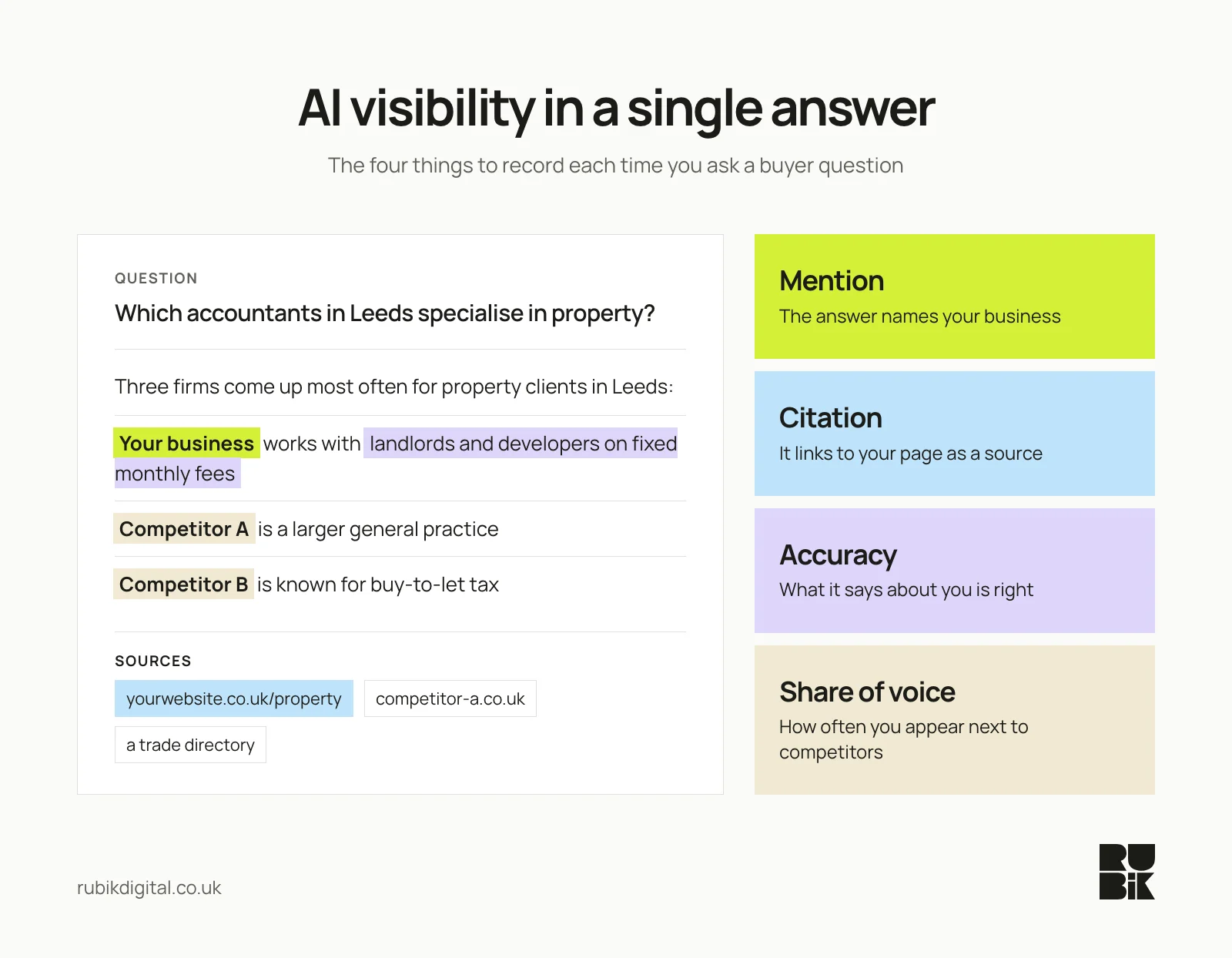
Ask an assistant which accountants in Leeds specialise in property, and it replies with a few names and perhaps some links. AI visibility describes whether you're among them, and what the assistant says about you when you are. It breaks down into four measures.
| Measure | What it tells you |
|---|---|
| Mentions | Whether the assistant names your business in its answer |
| Citations | Whether it links to one of your pages as a source |
| Accuracy | Whether what it says about your services, prices, locations and people is right |
| Share of voice | How often you're named compared with your competitors, across the same set of questions |
The four don't always move together. An assistant can recommend you by name using what a directory or a review site says about you, without linking to your website. It can also cite your pricing guide in an answer that recommends someone else. Record each one separately.
Most tracking tools add a fifth measure, sentiment: whether the answer describes you positively, neutrally or negatively.
You'll also see the same idea called AI search visibility, LLM visibility or AI brand visibility. LLM stands for large language model, the technology behind ChatGPT and the other assistants.
How is AI visibility different from SEO?
SEO gets your pages to rank in search results, and you measure it in positions, clicks and enquiries. With AI visibility there's no position to hold. The assistant writes its own answer and names whoever it chooses, and the reader may never visit your website.
| Search results | AI answers | |
|---|---|---|
| What you're aiming for | A high position for a search | A mention or a citation in the answer |
| How stable it is | Positions shift, but people searching in the same place see much the same page | The same question can get a different answer each time it's asked |
| How it's measured | Search Console reports every impression and click | Google and Microsoft report part of it. For the rest, you sample questions and read the answers |
| What the reader does next | Clicks through to a website | Often reads the answer and stops there |
The two share their foundations. Google says there are no additional requirements to appear in AI Overviews or AI Mode: a page has to be indexed and eligible to show with a snippet, the same as a normal result. If your SEO foundations are weak, fix those first. Our guide to appearing in Google AI Overviews and AI Mode covers what Google asks for.
Where do AI assistants get their answers?
An assistant draws on two sources. One is what the model learned in training, which can be months out of date. The other is what it finds by searching the web at the moment someone asks. Google's AI features work the second way: they retrieve pages from the Search index and build the answer from what those pages say. ChatGPT, Claude and Perplexity send their own crawlers to do the same job.
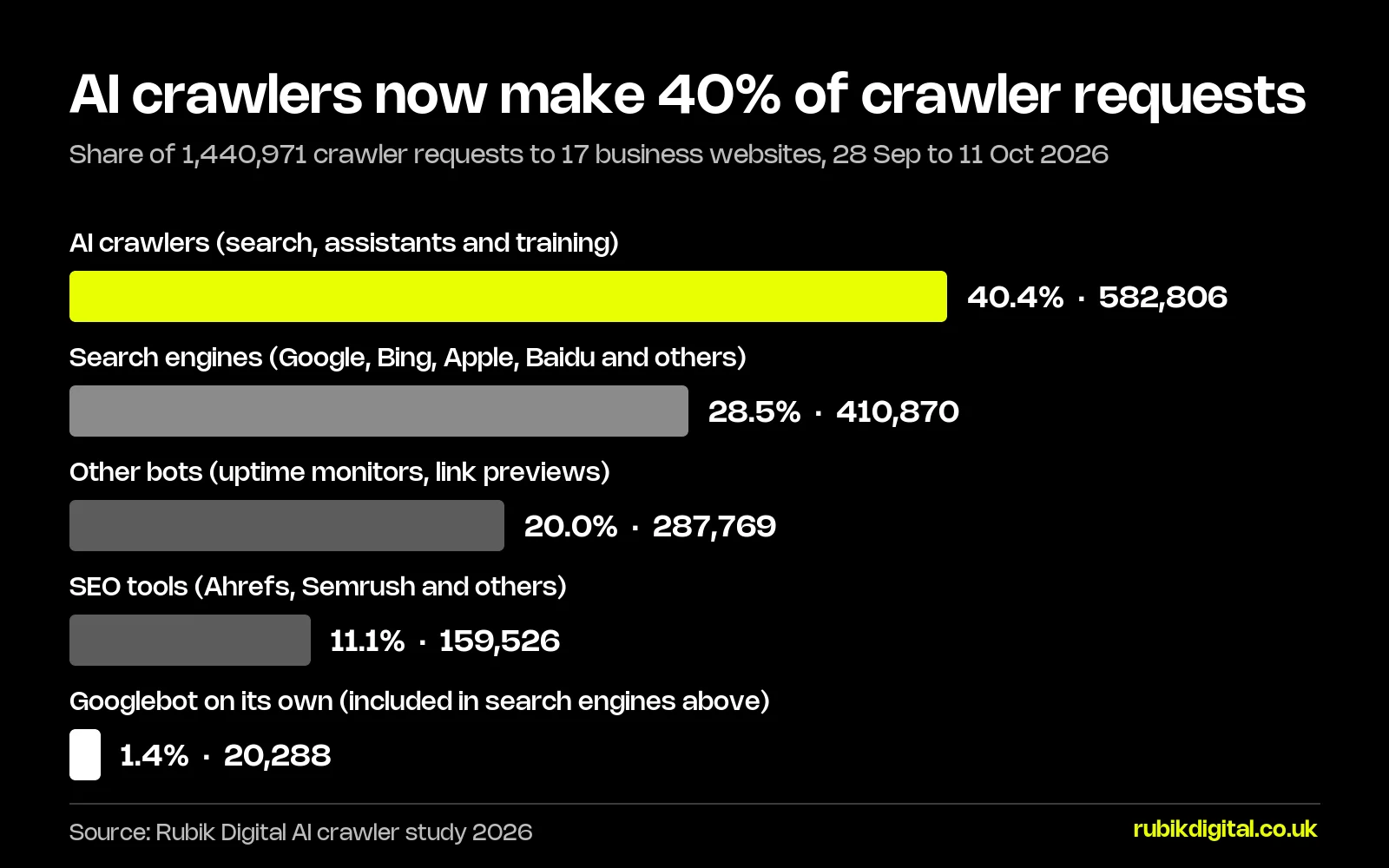
Those crawlers now make up a large share of the automated traffic a website gets. When we analysed 1,440,971 crawler requests to 17 business websites we host, AI crawlers made 40.4% of them, more than Google, Bing and every other search engine combined. Two-thirds of the AI crawling was for search and answers, and a third was for training models. ChatGPT and Claude also fetched pages live, because someone had just asked them a question, more than 13,000 times in two weeks.
So AI visibility starts with access. If your robots.txt file or your CDN blocks AI search crawlers, those assistants can't read your site and can't recommend it. If your prices or service descriptions only appear once JavaScript has run, most AI crawlers never see them, because GPTBot, OAI-SearchBot, ClaudeBot and PerplexityBot read only the HTML the server sends. Our JavaScript SEO guide shows how to check.
Assistants also repeat what other websites say about you. Reviews, directories, trade press and independent comparisons all feed the answer, which is how a business gets recommended by name when its own site isn't cited.
How to check your AI visibility
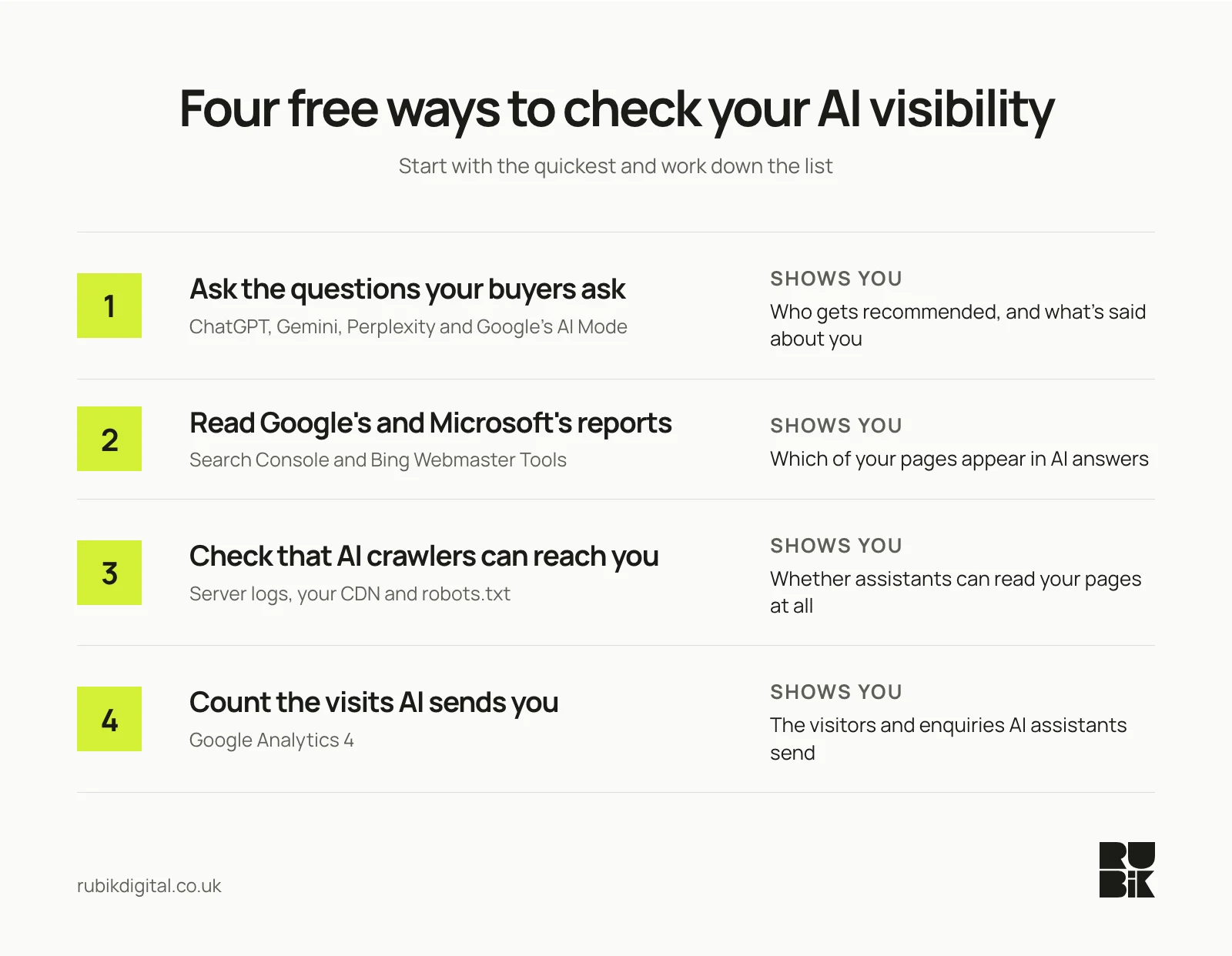
You can get a fair first reading in an afternoon without paying for anything. There are four checks. Start with the quickest and work down.
1. Ask the questions your buyers ask
Open a private or temporary chat in ChatGPT, Gemini, Perplexity and Google's AI Mode, so earlier conversations don't sway the answer. Ask five to ten questions the way a buyer would, in full sentences, without naming your business. Note who is recommended, whether you're mentioned, whether your site is linked and whether the facts about you are right. Then ask about your business by name and read the description for mistakes.
Our free AI visibility prompt pack has 25 buyer prompts and a scoring sheet, so you can repeat the same check each month.
2. Read the free reports from Google and Microsoft
Google Search Console has a generative AI performance report that shows how often your pages appeared in AI Overviews and AI Mode, by page, country, device and date. Bing Webmaster Tools has an AI Performance report that shows how often your pages are cited in Microsoft Copilot and Bing's AI summaries, along with the phrases the AI searched for when it picked your content. Neither report shows what the answer said about you.
3. Check that AI crawlers can reach your pages
Search your server logs, or your CDN's bot report, for OAI-SearchBot, ChatGPT-User, Claude-SearchBot and PerplexityBot. If they never appear, look in robots.txt for a rule that blocks them. If they do appear, look at how many of their requests fail. In our study, 1.6% of AI crawler requests ended in a server error, and an assistant that can't load your page will answer from someone else's.
4. Count the visits AI sends you
In Google Analytics 4, filter your traffic by session source for chatgpt.com, perplexity.ai, claude.ai, gemini.google.com and copilot.microsoft.com. You'll see which pages assistants send people to and whether those visitors enquire. Some AI apps don't pass on where a visitor came from, so the true figure is higher than GA4 shows.
Free AI visibility checkers
Several SEO companies offer a free AI visibility checker. You type in a brand name and it reports how often AI platforms mention it. Ahrefs' checker needs no signup and covers ChatGPT, Gemini, Perplexity, Copilot and Google's AI Overviews. It lists the topics you're mentioned for and the pages cited alongside you.
A checker is fine for a first look. Its limit is that the tool picks the questions, and they may have little to do with what your buyers ask. For tracking with your own prompts, our comparison of AI visibility tools covers six paid trackers and what each costs. To check your website's groundwork, our free AI search scorecard asks 16 questions about access, content, trust and measurement, takes about five minutes and lists the fixes to start with.
What is an AI visibility score?
Most tracking tools reduce their results to one number. Semrush shows an AI Visibility score out of 100. Similarweb reports the percentage of tracked answers your brand appears in. Each vendor uses its own prompts, its own mix of assistants and its own formula, so 40 in one tool and 40 in another are different results.
A score is a sample. The tool asks a fixed set of questions on a schedule and counts how often you come up, and the same question can get a different answer on the next run. Treat it like a poll. It's useful for the direction over a few months and for comparing yourself with competitors inside one tool. One week's movement tells you very little.
A score also counts every mention the same. An answer that puts you first and an answer that lists you with a warning both add one to the total, so read a sample of the answers behind the number.
What does an AI visibility audit cover?
An AI visibility audit is a one-off check of where you stand and what to fix first. Ours tests your buyers' prompts in ChatGPT, Gemini, Perplexity and Google's AI answers, records the sources those answers draw on, checks the technical side and your structured data, and ends with a prioritised action plan. It takes 15 hours and costs £1,500.
Published UK prices for an AI visibility or GEO audit run from £495 to £1,800, and our guide to GEO costs in the UK lists who charges what. When you compare audits, ask how many prompts will be tested, on which assistants, and whether the same prompts are run for your competitors.
Download the free AI visibility prompt pack
Find out what AI assistants say about your business, and who they recommend instead.
- Prompt packPDF, 5 pages
- Scoring sheetExcel, 4 tabs
How to improve your AI visibility
Most of this is the work that helps you rank in Google, with a few additions. We'd do it in this order.
- Let AI search crawlers in. Allow the ones that fetch pages to answer a live question, such as OAI-SearchBot, ChatGPT-User, Claude-SearchBot and PerplexityBot. Whether you also block training crawlers such as GPTBot is a separate decision.
- Put what matters in the HTML. Prices, service descriptions and product details should be in the page the server sends, without needing JavaScript to run.
- Answer buyer questions in the first sentence or two of each main page, then expand under headings that match how people ask.
- Publish things only you know: results from real projects, your own prices, original data. Google says unique, useful content matters more than anything else for its AI features.
- Describe your business in structured data, in the HTML, and make sure it matches what the page shows. There's no special schema for AI.
- Keep your name, services, prices and locations the same on your website, Google Business Profile, LinkedIn and directories, so assistants don't repeat an old detail.
- Earn mentions where assistants look: independent comparisons, trade press and reviews on the platforms your buyers use.
What this looks like on real websites
For Black Brick, a London buying agency, we refreshed the buyer's guides so every answer carries a named reviewer and a date, added structured data describing the agency and its people, and run a monthly panel of prompts to see how ChatGPT, Google and Perplexity describe the firm. AI search traffic rose 119% and website enquiries 44%.
The Schoeman Clinic, a private clinic on Harley Street, has structured data for the clinic, its locations and its team, and condition guides that answer what patients research before they book. Comparing the three months to 25 November 2026 with the three months before, AI search traffic rose 700%.
Citations can be counted too. In November 2026, SE Ranking recorded Brooklands Interiors as a cited source in 346 UK AI answers, including 193 Google AI Overviews and 140 ChatGPT answers, on questions such as how big a kitchen island should be.
What AI visibility can't tell you
Mentions don't always bring visitors. People often read the answer and go no further, and Google still sends far more customers to the websites we host than any AI tool does. Read your AI figures next to your search data.
It can't show revenue either. Trackers count mentions and citations. To see whether those turn into business, check which AI referrals go on to enquire, and ask on your enquiry form how people found you.
No tool sees what a particular person saw. Answers change with the user's location, history and conversation, which is also why nobody can guarantee that ChatGPT or any other assistant will recommend you.
Is AI visibility worth your time?
It matters most where buyers research before they get in touch: professional services, property, private healthcare, finance and B2B software. Those buyers now ask an assistant who to shortlist and what it should cost. If you sell simple products to people who search a short phrase and buy straight away, ordinary SEO will carry most of the weight for now.
The first check costs nothing. Run the prompts, read the two free reports and see whether competitors are named where you're missing. Paid tracking or outside help makes most sense when they are.
If you'd like us to do it for you, our AI search visibility service tracks what the assistants say about you each month and fixes what holds you back. Generative engine optimisation covers the content and technical work behind it.